Choosing between stick pack and sachet packaging depends on your product and how you want people to use it. If you sell consumer packaged goods, you need safe packaging that is also easy for consumers to use. Sunkey Packaging can assist you in making the right choice between stick pack vs sachet packaging.
Sunkey Packaging specializes in flexible packaging solutions for various industries.
The company is committed to quality and environmental sustainability, ensuring that your products meet the highest standards.
Key Takeaways
Stick packs are long and thin. Sachets are flat and shaped like rectangles. Pick the one that fits your product best.
Sachet packaging costs less. It is made faster. This is good for products made in large amounts.
Stick packs help you control portions. They are great for single-use items like powders and drinks.
Both types keep products safe from air, light, and moisture. This helps keep them fresh.
Sachets have more room for branding and instructions. This makes your product easier to notice.
Think about the environment. Stick packs use less material. Sachets are harder to recycle.
Sunkey Packaging lets you customize both types. This makes sure they fit your brand.
Use the checklist and flowchart given. They help you pick the best packaging for your product.
Stick Pack vs Sachet Packaging Comparison
Overview Table
It is important to compare packaging types before you choose. The table below shows the main differences between stick pack and sachet pack packaging. You can see how they are different in shape, how much they hold, how fast they are made, how much they cost, and their effect on the environment.
Feature | Stick Pack Packaging | Sachet Pack Packaging |
Shape | Long, narrow tube | Flat, rectangular pouch |
Typical Volume | 1–15 ml/g | 1–50 ml/g |
Production Speed | Up to 600 units/hour | Up to 2,000 units/hour |
Cost per 10,000 Units | $0.50–0.75 | $0.30–0.45 |
Machinery | Vertical form-fill-seal | Horizontal form-fill-seal |
Initial Expenditure | 20–30% higher | Lower |
Barrier Properties | High barrier, temperature resistant | High barrier, temperature resistant |
Environmental Impact | Lower carbon, water, fossil fuel use | Varies by material |
Branding Area | Limited (front/back) | Larger print area |
User Experience | Easy to open, pour, and consume | Easy to tear, pour, or squeeze |
Sunkey Innovations | Biodegradable, recyclable, active | Biodegradable, recyclable, active |
Tip: If you want to make many packages quickly and spend less money, sachet pack packaging could be better for you. If you like a modern style and want to control how much comes out, stick pack packaging is a good choice.
Key Metrics
When you look at stick packs, sachets, and pouches, you should check some important things. These include how much they cost, how fast you can make them, how they affect the environment, and new ideas in flexible packaging.
Note: Sunkey Packaging cares about quality and the environment. This helps your consumer packaged goods look great and meet world standards.
Differences Between Stick Pack and Sachet
Shape & Size
You can tell stick pack and sachet packaging apart by their shapes and sizes. Stick pack packaging is long and skinny like a tube. Sachets are flat and shaped like a rectangle. These shapes help you pick what works best for your product.
Feature | Sachets | Stick Packs |
Shape | Flat and rectangular | Slim and tubular |
Best For | Liquids, powders, samples | Powders, granulated products |
Stick Pack Dimensions
Stick pack packaging is usually 1 to 15 centimeters long. It is also 1 to 3 centimeters wide. This makes a small tube that fits in your pocket or bag. The shape is good for single-serve powders and instant drinks. You can use stick pack packaging for products that need easy pouring and portion control.
Sachet Dimensions
Sachets come in many sizes. They can be 4 to 12 centimeters long and 4 to 8 centimeters wide. The flat shape is good for liquids, powders, and samples. Sachets give you more room for your brand and instructions. You can use sachets for food, makeup, and medicine.
Tip: Stick pack packaging looks modern and is easy to use. Sachets give you more space for your brand and work for many products.
Material & Sealing
Flexible packaging uses special materials and sealing to keep products safe. Sunkey Packaging is a leader in making strong packaging. Your products stay safe from water, air, and light.
Common Materials
Stick pack and sachet packaging use PET, aluminum foil, PE, and BOPP. Sunkey Packaging has high-barrier materials like PET/Al/PE and PA/EVOH/PE. These keep your products fresh and safe. You can also pick biodegradable and recyclable packaging to help the planet.
Sealing Methods
Sealing keeps your product safe inside the package. You can pick fin seals, lap seals, or peripheral seals.
Seal Type | Description | Effectiveness in Product Integrity |
Fin Seals | Edges folded together to create a fin | Gold standard for integrity and burst strength |
Lap Seals | One edge overlaps the other and is sealed | Ideal for material savings, less robust than fin seals |
Peripheral Seals | Seals run along every edge of the sachet | High-end look, risk of leaks if not calibrated properly |
Stick pack packaging often uses fin seals for strong protection. Sachets use peripheral seals for a fancy look and to stop leaks. Sunkey Packaging’s Medical Reagent Strip Packaging uses many layers and careful sealing. This keeps medical products safe. You get packaging that meets tough rules.
Filling Capacity
You need to know how much each package can hold. Flexible packaging gives you different choices for filling capacity.
Volume Range
Stick pack packaging holds 1 to 10 grams. Sachets can hold a few grams or even more. You can pick the size that fits your product.
Packaging Type | Filling Capacity Range |
Stick Pack | 1 to 10 grams |
Sachet | A few grams to several dozen grams |
Product Types
Stick pack packaging is used for single-serve medicine, instant drinks, and snacks you can take with you. Sachets are used for sauces, makeup samples, and home products.
Packaging Type | Common Product Types | Reasons for Use | Supporting Industry Data |
Stick Packs | Single-serve medications, instant beverages, travel snacks | Precise dosing, portability, leak-proof | 70% of liquid pharmaceuticals use stick packs; 68% of instant coffee uses stick packs |
Sachets | Condiments, cosmetic samples, household products | Leak-proof, branding space, single-use appeal | 65% of Asia-Pacific fast-food chains use sauce sachets; 80% of luxury skincare brands use sachets |
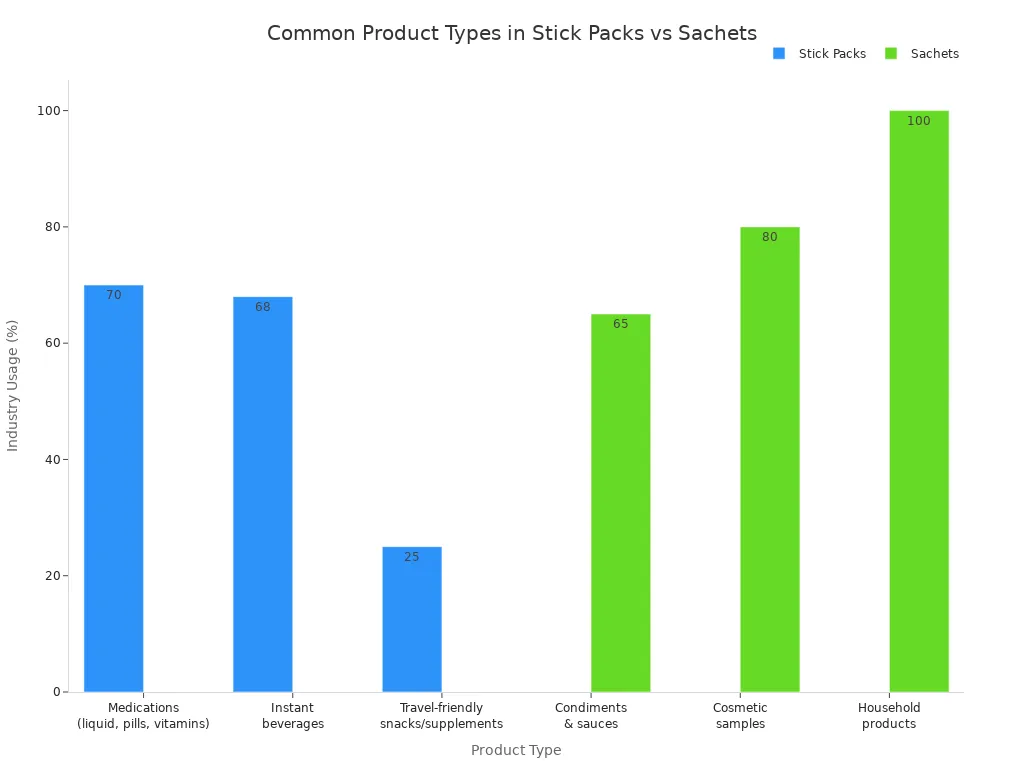
Stick pack packaging is good for easy use and portion control. Sachets are flexible and have more space for your brand. Sunkey Packaging lets you pick the best packaging for your product and industry.
User Experience
Opening Ease
You want packaging that is quick and easy to open. Stick packs make this simple for everyone. You just tear off the top and pour it out. This is great when you need to use powders or liquids fast. Stick packs are common for instant coffee and energy drinks. The small opening helps stop spills and messes.
Sachets feel different when you open them. You tear the edge, but the wide opening can spill powder. Sachets are good for creams and samples. Some sachets can close again, but this does not always stop messes. Sachets can be harder to use if you need to pour into a small bottle.
Feature | Stick Pack | Sachet |
Ease of Pouring | Excellent (direct pouring, minimal spillage) | Less convenient, especially for powders |
Stick packs are easy to tear and pour, so they are good for travel.
Sachets can close again, but the wide opening can spill.
Tip: Stick packs are fast and clean to open and use. Sachets are flexible but need more care when you open them.
Dispensing
How you get the product out is important. Stick packs let you pour straight out with little waste. You can control how much comes out and avoid spills. This is good for things like medicine powders or instant drinks.
Sachets have more space, but the big opening can make pouring tricky. You might squeeze out creams or gels, which is good for makeup. Sachets are best for things you do not need to measure or that you put on your skin.
Stick packs are best for pouring into another cup or bottle. Sachets are better for squeezing or applying the product.
Branding Potential
Print Area
You want your package to look special. Stick packs look modern and slim. There is less space to print, so you show your logo and main info. This style is good for people who like simple and cool designs.
Sachets have more room for pictures and words. You can add graphics, instructions, and ads. Sachets help you tell your brand story and stand out in stores.
Packaging Type | Branding Opportunities | Customization Options |
Stick Packs | Sleek design, modern appeal, ideal for branding | High customization for branding and product info |
Sachets | Larger surface area for detailed branding, versatile | More creative freedom in design, suitable for marketing campaigns |
Note: Sachets give you more space to show your brand. Stick packs look modern and fit many products.
Customization
You can change both stick packs and sachets to match your brand. Stick packs let you pick colors, logos, and info. You make packaging that fits your brand and what your customers like.
Sachets give you even more ways to be creative. You can use fun shapes, shiny finishes, and cool designs. Sachets are great for ads and new products. You can grab attention with bright and bold packaging.
Sunkey Packaging helps you make packaging that works for you. You get strong materials and great printing. You can show your brand and connect with buyers.
Tip: Customizing helps you make packaging that fits your brand and product. Sunkey Packaging gives you expert help for both stick pack and sachet designs.
Stick Pack vs Sachet Packaging Similarities
Portability
You need packaging that is easy to carry. Both stick pack and sachet pack packaging are great for travel. You can put them in your pocket, backpack, or purse. This makes them good for busy days at school or work. Many people think stick packs are easier to use because they are slim. Stick packs are also cleaner and simple to hold. You get the right amount every time, so there is less mess.
Stick pack packaging fits in your hand or pocket.
Sachet pack packaging is flat and light, so you can carry more.
Both types keep your single-serve products safe when you are out.
Sunkey Packaging makes flexible packaging for your busy life. You can count on both types to be easy and helpful anywhere.
Single-Serve Convenience
You want packaging that is simple to use. Stick pack and sachet pack packaging are made for single-serve use. They are quick and easy to open. You can enjoy your product right away. This is perfect for drink mixes, snacks, or health supplements.
Stick packs are small and fit in a pocket or bag.
Sachet pack packaging is great for single-serve and fast use.
Both types let you pour out just what you need.
Each stick pack has a set amount, so you do not waste.
The strong film in both keeps your product fresh.
Stick packs and sachets are light and easy to open, good for students and travelers.
Flexible packaging from Sunkey Packaging helps you get the most from every single-serve product. You save time and have a better experience.
Product Protection
You want your products to stay safe and fresh. Both stick pack and sachet pack packaging protect against water, air, light, and germs. This keeps your food, medicine, or makeup in good shape.
Protection Type | Description |
Moisture Protection | Stops clumping, mold, or damage from water. |
Air and Oxygen Barrier | Keeps out air, so flavors and nutrients last. |
Light Resistance | Blocks light to protect things that are sensitive. |
Contamination Prevention | Keeps out dust, germs, and other bad things during shipping or storage. |
Sunkey Packaging uses strong materials to keep your products safe. You can trust both stick pack and sachet pack packaging to keep things fresh. The company also cares about the planet, so you help the earth with every package.
Note: When you pick Sunkey Packaging, you get packaging that is easy, safe, and good for the environment for all your single-serve needs.
Application Suitability
Food & Beverage
Powders
Stick pack and sachet packaging are often used for powders in food and drinks. If you sell protein powder or instant coffee, you want packaging that keeps it fresh and simple to use. Stick packs are good for single-serve protein powder and supplement mixes. Sachets are common for seasoning powders and sugar packets. Flexible packaging keeps powder safe from water and air, so customers get good quality.
Packaging Type | Suitable Products | Market Trends |
Stick Packs | Protein powder, supplement mixes, instant beverages | 25% increase in travel-size stick pack sales in 2023 |
Sachets | Seasoning powder, sugar, condiments | 65% of Asia-Pacific fast-food chains use sauce sachets |
Tip: Stick packs help with portion control and pouring. Sachets give more space for branding and instructions.
Liquids
Flexible packaging is also great for liquids. You can use stick packs for liquid supplement shots or energy drinks. Sachets are best for sauces, salad dressings, and small drink samples. Both types keep liquids safe from leaks and germs. Sunkey Packaging gives strong seals and high barrier materials for your liquid products.
Pharmaceuticals
Medical Reagent Strip Packaging by Sunkey Packaging
Pharmaceuticals need safe packaging. Sunkey Packaging’s Medical Reagent Strip Packaging meets strict rules. The multi-layer design protects things like nucleic acid test reagents and enzyme preparations. You get strong barriers, with oxygen transmission rate ≤0.3 cm³/m²·day and water vapor barrier ≤0.5 g/m²·day. Sunkey Packaging has ISO9001, BRC, SGS, FDA, and FSSC22000 certifications. You can trust this flexible packaging for safety and reliability.
Feature | Specification |
Oxygen Transmission Rate | ≤0.3 cm³/m²·day |
Water Vapor Barrier | ≤0.5 g/m²·day |
Material Composition | Multi-layer composite (PET/Al/PE or PA/EVOH/CPP) |
Nutraceuticals
Supplements need packaging that keeps them safe and easy to use. Stick packs and sachets are great for single-serve powders, capsules, and tablets. Flexible packaging keeps supplements safe from water and air. You can add clear labels and tamper-evident features to follow the rules. Sunkey Packaging helps you meet Good Manufacturing Practices and labeling needs.
Key Consideration | Description |
Material Standards | Packaging must not react with supplements to keep them stable and strong. |
Tamper-Evident Features | Needed to show if the product was opened, keeping consumers safe. |
Labeling Requirements | Labels must have the supplement name, dosage, and expiration date. |
Cosmetics
Creams
Stick packs and sachets work for creams in cosmetics. Flexible packaging keeps creams fresh and easy to use. Stick packs are handy for travel-sized creams and lotions. Sachets are good for bigger samples and special events.
Samples
Stick packs and sachets are perfect for cosmetic samples. You can let customers try new products. Flexible packaging is easy to fill and print, so it is great for marketing. You can use pre-made sachets or printed roll stock for quick samples.
Sampling new products
Good for travel
Useful for promotions
Note: Sunkey Packaging gives custom flexible packaging for every industry. You get high-quality packaging that fits your needs and helps your brand stand out.
Other Industries
Chemicals
Sometimes chemicals need special packaging to stay safe. Stick pack and sachet packaging both protect chemical products well. You can use these for things like cleaning powders or water treatment agents. They also work for single-use laboratory chemicals. These packages help you use the right amount each time. This keeps people safe and stops waste.
Sunkey Packaging uses strong materials that block water, air, and light. This helps your chemicals stay good and work well. You can pick different material types, like PET/Al/PE or BOPP/CPP, for your product. Sunkey also makes packaging that does not rip or tear easily. This means your chemicals are safe when shipped or stored.
Tip: If you use dangerous or sensitive chemicals, you need packaging with tamper-evident features. Sunkey Packaging can add these features to help you follow safety rules.
You can also choose eco-friendly packaging. Sunkey Packaging has recyclable and biodegradable materials. This helps you follow green rules and protect the planet.
Chemical Product Type | Recommended Packaging | Key Benefit |
Cleaning Powders | Stick Pack | Easy dosing, no mess |
Water Treatment Agents | Sachet | Safe handling, single-use |
Laboratory Chemicals | Stick Pack/Sachet | Accurate portion, safety |
Pet Products
You want pet products to be safe, fresh, and simple to use. Stick pack and sachet packaging are good for pet vitamins, treats, and shampoos. These packages make it easy for owners to give the right amount every time.
Stick packs are best for powders or liquid supplements. You can pour them into pet food or water. Sachets are great for wet treats, samples, or one-time shampoos. Both types keep pet products fresh by blocking air and water.
Sunkey Packaging makes packaging that fits your pet product. You can pick materials that keep smells in and stop leaks. Sunkey also uses strong seals and easy-open features. This helps pet owners open and use the product easily.
Note: Sunkey Packaging has certifications like ISO9001 and FDA. You can trust your pet products will be safe and high quality.
Key Advantages for Pet Products:
You can work with Sunkey Packaging to make packaging that stands out. This helps you earn trust from pet owners and grow your business.
Pros and Cons
Stick Pack Pros
Stick packs have many good points. They are small and light, so you can carry them anywhere. This makes them great for travel, school, or work. Each stick pack gives you the right amount for one use. You do not need to guess or measure. You can enjoy different flavors in one box. This makes your product more fun and flexible.
Every pack gives you a full dose.
You can try many flavors without buying a big box.
Stick packs are easy to use at home or outside.
Many people like stick packs because they are simple to open and use. You do not need scissors or extra tools. The packaging keeps your product fresh and safe from air and water. This helps you enjoy your food, drink, or medicine at its best.
More people want stick pack packaging because it is easy and gives portion control. You can see this in many single-serve products today.
Stick Pack Cons
Stick packs also have some problems. The small size gives you less space for your brand or product information. If you need to share lots of details, this can be hard. Sometimes, you need more than one stick pack for a single use, especially for bigger servings.
Disadvantage | Description |
Limited Branding Space | Small size limits branding and labeling chances, making it hard to show detailed information. |
Single-Use Packaging | Makes more waste if not thrown away right, raising environmental worries. |
Potential for Overpackaging | Can cause too much packaging when many sticks are bundled, taking away environmental benefits. |
Stick packs hold less, so they do not work well for big products.
You may need to use several packs at once.
Stick packs can take longer to fill and seal than other packaging types. The cost to start using flexible packaging films can be higher, which may affect your budget.
Sachet Pros
Sachet packaging has many good points for you and your customers. Sachets keep products airtight, so everything stays fresh until you open it. You use the whole product at once, so you do not need to reseal or worry about waste. Sachets are light and easy to carry, making them great for travel or busy days.
Benefit | Description |
High Convenience | Lightweight and portable, ideal for many situations, giving accurate single dosages to stop waste. |
Low Cost and High Efficiency | Cost-effective for brands testing new markets, needing less raw materials and flexible production. |
Good Sealing and Protection | High-barrier materials make shelf life longer and keep products stable. |
Strong Customizability | Custom designs help brand communication and recognition. |
Environmentally Friendly | Offers recyclable and degradable options, matching consumer demand for sustainability. |
Sachets can hold many types of products, like cleaning supplies, nutraceuticals, and cosmetics.
You can buy sachets at a lower price, which helps people with smaller budgets.
Sachets let more people try high-quality products without buying large amounts.
You can also design sachets in many ways to show off your brand. This helps your product stand out on the shelf and attract more customers.
Sachet Cons
Sachet packaging has some problems you should know about. Many brands pick sachets because they are light and easy to carry. But there are a few things to think about before you choose sachets for your products.
Environmental Impact
Sachets often use single-use plastics. Most sachets are made from plastic and used one time. After opening, you throw the sachet away. These plastics are hard to recycle. Many sachets end up in landfills or water. This causes problems for the earth and adds to plastic pollution.
Recycling Difficulty
It is hard to recycle sachets. The materials in sachets have layers of plastic, foil, or paper. Recycling centers cannot pull these layers apart easily. This makes sachets less good for the earth than other packaging.
Many countries now want brands to use packaging that is easier to recycle. You may need to follow new rules about packaging waste. Sachets can make it harder for your business to meet these rules.
Limited Resealability
Sachets usually do not reseal. Once you open a sachet, you must use all the product. If you do not finish, you cannot save it for later. This can cause waste, especially for products used in small amounts.
Potential for Spillage
Sachets can be tricky to open. The wide opening can spill powder or liquid. This makes sachets less handy for products that need careful pouring. You may need to be careful to avoid a mess.
Branding Space Constraints
Sachets have more print space than stick packs, but there are still limits. If you want to add lots of instructions or branding, the flat shape can make it hard. You must plan your design to use the space well.
Sachets are good for samples and single-use products. Think about how your customers will use the packaging. If you want to cut waste and help the earth, you may need to look for recyclable or biodegradable sachets.
Sachet packaging has some downsides. You should think about these problems and the good points. If you want your brand to be greener, you can pick eco-friendly materials and work with experts. Sunkey Packaging has new ideas to help you reach your green goals and keep your products safe and easy to use.
Decision Guide
Checklist
You want to pick the best packaging for your product. Start with a simple checklist. This helps you make good choices and avoid mistakes.
Think about how you will use the packaging. Is it for stores, your own brand, or just for yourself?
Check if you need special certifications. Some products need vegan, keto, or non-GMO labels.
Ask for the ingredient list and nutrition facts. Make sure you know what is inside.
Look for allergens or banned things. Your packaging should not have anything unsafe or not allowed.
See if your supplier has experience. Ask if they can ship to other countries and speak your language.
Try out samples. Test how the product mixes, tastes, and if the package is strong.
Read the supplier’s rules. Stay away from suppliers who do not give batch certificates or clear order amounts.
Finish the contract details. Make sure your contract talks about sample quality, your ideas, and help after you buy.
Tip: Use this checklist to compare stick pack and sachet packaging. You will see which one works best for your product and business.
Flowchart
A flowchart can help you choose between stick pack and sachet packaging. Follow each step to find your answer.
Step | Question | If Yes | If No |
1 | Is your product single-serve? | Go to Step 2 | Think about bulk packs |
2 | Is portion control important? | Stick pack | Go to Step 3 |
3 | Do you need a big print area? | Sachet | Go to Step 4 |
4 | Is fast production needed? | Sachet | Stick pack |
Note: If you are still not sure, ask Sunkey Packaging for help. They can give you advice and custom packaging ideas.
Mistakes to Avoid
You want to stay away from common mistakes when picking packaging. These mistakes can waste your time and money.
Always test samples. Check how your product looks and feels in the package.
Make sure you understand the contract before signing.
Do not forget about certifications. Your packaging must follow the rules.
Stay away from suppliers who do not say how many you must order or how long it takes.
Remember to check branding space. Pick packaging that fits your marketing plans.
Callout: Sunkey Packaging helps you avoid these mistakes. You get help from start to finish, so your packaging process is easy and smooth.
This guide helps you make smart choices. Stick pack and sachet packaging both have good points. Flexible packaging gives you many options for different products. If you need help, Sunkey Packaging can give you expert advice and custom solutions.
You can easily tell stick pack and sachet packaging apart. Stick packs are best for powders and when you need exact amounts. Sachet packs are good for liquids and creams. They are made quickly and cost less money. Both types keep products safe and are easy to use for one time.
Choose stick pack vs sachet packaging | When to Use |
Stick pack | When you want exact amounts, easy carrying, or care about the planet |
Sachet pack | For liquids, selling a lot, or saving money |
Sunkey Packaging uses lots of information to help you pick the right sachet pack packaging. Look at the decision guide and table to make a smart choice. Ask Sunkey Packaging if you want special help.
FAQ
What is the main difference between stick pack and sachet packaging?
Stick packs are long and skinny like a tube. Sachets are flat and shaped like a rectangle. Stick packs help you control how much you use. Sachets give you more space to show your brand.
Can I use stick packs for liquids?
You can put liquids in stick packs, like energy shots or supplement drinks. Stick packs keep liquids safe and make pouring easy. Sunkey Packaging uses strong seals so liquids do not leak.
Are stick packs and sachets recyclable?
You can pick recyclable stick packs and sachets. Sunkey Packaging has materials that break down or can be recycled. This helps you make less trash and care for the earth.
Which packaging is better for branding?
Sachets have more room for your brand and instructions. Stick packs look cool but have less space for printing. You choose what works best for your marketing plan.
How do I select the right packaging for my product?
Think about your product, how much you want in each pack, and how you want it to look. Use the checklist and flowchart in this blog to help you. Sunkey Packaging can give you advice if you need it.
Does Sunkey Packaging offer custom solutions?
You can get custom packaging for food, medicine, makeup, and more. Sunkey Packaging changes the materials, sizes, and designs to fit what you need.
What certifications does Sunkey Packaging hold?
Sunkey Packaging has ISO9001, BRC, SGS, FDA, and FSSC22000 certifications. You can trust that your packaging is safe and high quality.


