To maintain meat's freshness, safety, and flavor for an extended period, it’s essential to explore different packaging concepts and methods for preserving meat quality. The most effective approach involves selecting packaging materials that provide strong barriers against oxygen and water. The table below highlights how various packaging materials contribute to meat preservation:
Packaging Material
Oxygen Barrier
Water Barrier
Strength
Polyvinylidene chloride
Low
High
High
Polyester
Low
High
High
Polyamide
Low
High
High
These materials are designed to slow down spoilage and ensure the meat remains safe and enjoyable to consume. Innovative companies like Sunkey Packaging specialize in offering different packaging concepts and methods for preserving meat quality, providing advanced solutions tailored to meet diverse needs. Use this guide to select the ideal packaging that aligns with your requirements.
Key Takeaways
Pick packaging that stops oxygen and moisture. This helps keep meat fresh and safe.
Vacuum packaging and modified atmosphere packaging make meat last longer. They take away oxygen and use special gases.
Shrink packaging keeps moisture inside. It stops meat from going bad. This is good for keeping meat quality high.
Think about the kind of meat and how long you will store it. This helps you choose the best packaging.
Look for eco-friendly packaging. It protects your meat and the planet.
Key Factors in Preserving Meat Quality
Oxygen and Spoilage
Oxygen affects how fast meat goes bad. When meat touches oxygen, different things happen. Oxygen makes fats break down faster. This causes the meat to spoil. Microbes that need oxygen grow quicker. This leads to meat spoiling sooner. Cured meats must have all oxygen removed. This stops color loss from photo-oxidation.
You can slow these problems with special packaging. Vacuum packaging and modified atmosphere packaging help. They take away or lower oxygen. This keeps meat fresh and helps keep its color and taste.
Moisture and Texture
Controlling moisture is important for meat texture. If meat loses too much water, it gets dry and tough. If it keeps too much water, microbes can grow more. Drying, refrigeration, salt, and sugar help control water. These steps keep meat texture right. They also stop microbes from growing. This is important for meat quality and safety.
Microbial Growth and Safety
Fresh meat lets microbes grow because it has nutrients. Here are some common problems. Aerobic bacteria grow when there is oxygen. These include Acinetobacter, Moraxella, and Pseudomonas. In places with less oxygen, lactobacilli can spoil meat. This happens if the meat has low pH. Higher pH meats can attract other bacteria. This causes bad smells.
Packaging helps by lowering oxygen and adding antimicrobial agents. This slows or stops microbe growth. It is important for keeping meat safe and good.
Role of Packaging in Meat Preservation
Packaging does more than just cover meat. It protects meat from oxygen, moisture, and microbes. Vacuum packs and modified atmosphere packaging remove oxygen. This stops spoilage and keeps meat looking nice. Active and antimicrobial packaging can release things that stop microbes. These methods are needed to keep meat quality and shelf life longer. Good packaging keeps meat safe, fresh, and nice to eat.
Different Packaging Concepts and Methods for Preserving Meat Quality
If you want to keep meat fresh and safe, you need to know about different packaging methods. Each method uses special ways to protect meat from going bad, keep its color, and help it last longer. Here are the main choices you can pick.
Vacuum Packaging for Extended Shelf Life
Vacuum packaging is a popular way to keep meat fresh. Most of the air is taken out of the package. This stops oxygen from touching the meat. Without oxygen, bacteria that spoil meat cannot grow well. Here is how vacuum packaging helps:
It slows meat spoilage by removing oxygen.
It stops bacteria that need air, like pseudomonads.
It keeps meat color stable so it looks fresh.
It protects against humidity and oxidation.
It helps preserved products stay shelf-stable by blocking air and moisture.
Vacuum-packaged meat stays fresh longer than meat wrapped in paper or plastic wrap. You can use vacuum packaging for beef, poultry, and other meats. This method gives you a longer shelf life and helps stop freezer burn. It also keeps the flavor and texture of your meat. You waste less food and enjoy better safety.
Modified Atmosphere Packaging (MAP) and Meat Preservation
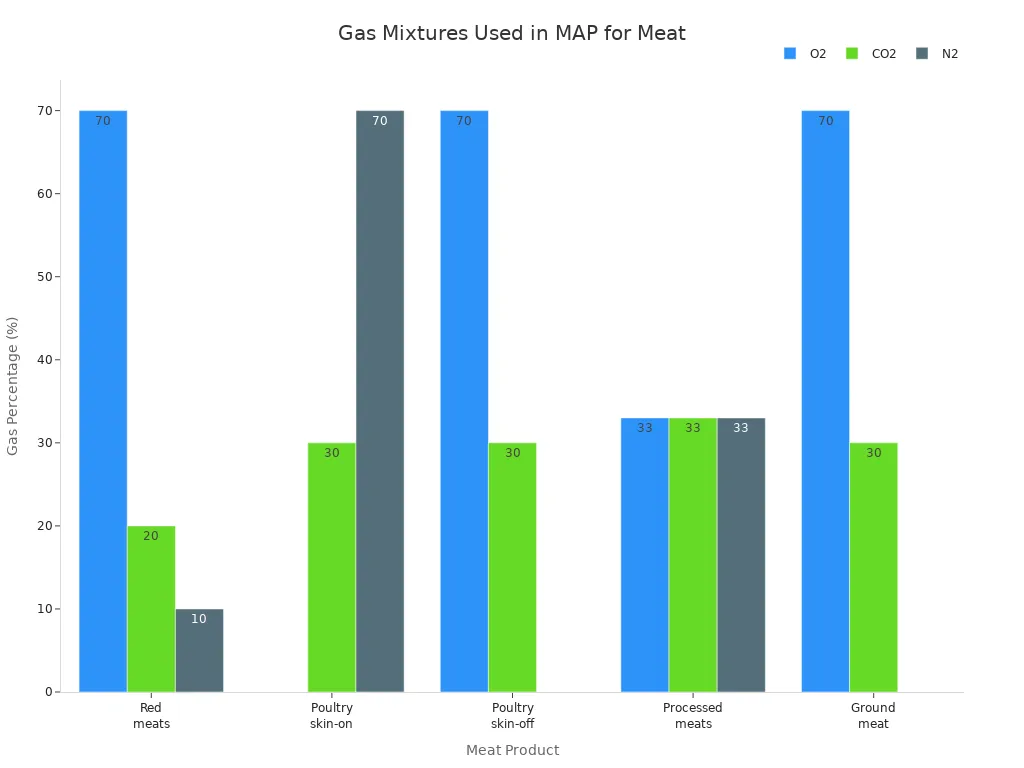
Modified atmosphere packaging is another important way to keep meat safe and fresh. In this method, the air inside the package is changed to a mix of gases. These gases slow spoilage and keep meat looking good. Different meats need different gas mixes. Here is a table that shows the best gas mixes for each meat:
Prevents oxidation and rancidity, inhibits microbial growth
Sausages
70% N2 / 30% CO2
Prevents oxidation and inhibits microbial growth
You can see that modified atmosphere packaging uses different mixes for each meat type. For example, beef needs more oxygen to keep its red color. Chicken needs more carbon dioxide or nitrogen to stop spoilage. This method gives you a longer shelf life and keeps your meat safe.
Modified atmosphere packaging has changed how you store meat. By changing the air inside the package, you can keep meat fresh, tasty, and safe for longer. Here is a chart that shows the gas mixes for different meats:
Shrink Packaging and Freshness
Shrink packaging is another way to keep meat fresh. You wrap the meat in a special plastic film. Then you heat the package so the film shrinks tightly around the meat. This method uses simple ideas to protect your food. Here are some benefits of shrink packaging:
It lowers contact with air, which locks in moisture and stops spoilage.
It keeps meat juicy by holding in water.
Shrink wrap stops cross-contamination with other foods.
The tight seal stops leaks and keeps your fridge clean.
You can stack and store shrink-wrapped meat easily.
The clear film lets you see the color and texture of the meat.
Shrink packaging gives you a longer shelf life and keeps your meat looking and tasting fresh.
Antimicrobial and Functional Packaging by Sunkey Packaging
Sunkey Packaging uses new ideas in antimicrobial and functional packaging. These advanced methods use special materials that fight bacteria and keep meat safe. Sunkey Packaging offers solutions that do more than block air and moisture. Their antimicrobial packaging can release safe agents that stop bacteria from growing. This helps you get a longer shelf life and better safety for your meat.
Functional packaging from Sunkey Packaging also includes high-barrier films, temperature-resistant materials, and easy-tear options. These features make it easier for you to store, open, and use meat products. Sunkey Packaging’s focus on sustainability means you can pick packaging that protects your food and the environment.
Tip: If you choose antimicrobial or functional packaging from Sunkey Packaging, you get the newest technology for meat preservation and help the planet.
Traditional Packaging Methods
Traditional packaging methods, like butcher paper and wax paper, use simple ideas. You wrap the meat to protect it for a short time. These methods let air reach the meat, which can make it spoil and dry out faster. They are easy to use and cost less, but they do not give you a longer shelf life. Modern methods, such as vacuum packaging and modified atmosphere packaging, make airtight seals. These seals keep meat fresh much longer and lower the risk of contamination.
If you need to store meat for a short time, traditional wraps work well. For longer storage and better safety, you should use modern packaging methods.
By learning about these different packaging methods, you can pick the best option for your needs. Whether you use vacuum packaging, modified atmosphere packaging, shrink packaging, or advanced solutions from Sunkey Packaging, you can keep your meat fresh, safe, and tasty for a longer shelf life.
Comparing Packaging Methods for Meat Preservation
Suitability for Different Meat Types
You can pick different packaging methods for each meat type. Each method works better for some meats than others. Here are some important things to know:
Vacuum packaging and Modified Atmosphere Packaging (MAP) help meat last longer. They work well for beef, pork, poultry, and fish.
Vacuum packs keep the color of beef and pork by taking out oxygen.
MAP uses special gases to keep chicken and fish fresh and safe.
Vacuum packs let juices stay around the meat. MAP uses pads to soak up juices, which can change how the meat looks.
You should match the packaging method to the meat type for the best results.
Short-Term vs. Long-Term Storage
Think about how long you want to keep your meat. Some ways are better for short times, and others are better for long times.
Raw beef or cooked sausages spoil fast and need cold storage at or below +5°C.
Semi-dry sausages also need to be cold, but at or below +10°C.
Dried meat can stay on the shelf and does not need a fridge.
Packaging that blocks oxygen helps stop spoilage and keeps meat safe.
Opaque or colored films keep light away, so meat does not spoil as fast.
Benefits and Limitations Overview
You can look at the table below to compare the main packaging methods. This helps you see which one is best for you.
Packaging Method
Benefits
Limitations
Vacuum Packaging
Makes meat last longer, stops spoilage
Color can change if oxygen gets in
Modified Atmosphere (MAP)
Keeps meat fresh, helps it last longer
Needs careful gas control
Shrink Packaging
Holds in moisture, stops germs
Not as good for long storage
Antimicrobial Packaging
Stops bacteria, makes meat safer
May need special materials
Tip: Use vacuum packaging for big pieces of meat. MAP is good for meat that needs to look fresh. Antimicrobial packaging from Sunkey Packaging gives extra safety and helps the environment.
Pick the best packaging by thinking about the meat, how long you want to store it, and how safe you want it to be.
There are many packaging materials you can use for meat. Each one protects meat in its own way. Here are some common choices you might find:
Film wrapping keeps out air and water.
Vacuum gas flushing takes out air and adds special gases.
Heat-shrink packaging wraps tight to keep meat fresh.
For high-temperature sterilization, you can use PA (PET)/CPP, EVAL/CPP, or PA (PET)/Aluminum foil/CPP.
Dried meat products often use BOPP/PA (PET)/PE, BOPP/PVA/PE, or FT/PE.
Aluminum-plated PA (BOPP)/PE and BOPP/Aluminum foil/PE block light from reaching the meat.
Sausage casings help sausages keep their shape and stay fresh. They use materials that let air in and seal well.
Pick your packaging material based on the meat type and how long you want to store it.
Material Properties and Extended Shelf Life
How well packaging works depends on its properties. Good barriers stop oxygen and water from getting in. This helps keep meat from spoiling and makes it safe to eat. Look at the table below to see how different films work:
Film Type
Weight Loss (%) on Day 15
Barrier Property (WVP)
TBARS Reduction (%)
Control SPI Film
8.5 ± 0.6
High
>50
SPI-SBP 3% Film
6.1 ± 0.4
Lower
30
PE Film
4.2 ± 0.3
Very Low
N/A
PE film lets very little water vapor through. This means less weight loss and better meat quality. Some packaging even uses probiotic strains like Lactobacillus plantarum to fight bacteria and keep meat safe longer.
Sustainability and Sunkey Packaging Solutions
You can help the earth by picking packaging that is good for the environment. Sunkey Packaging uses eco-friendly materials that protect meat and cut down on waste. Their solutions use strong films, layers you can recycle, and new technology. This keeps meat fresh and helps the planet. When you choose Sunkey Packaging, you get safety, quality, and a better future for everyone.
Tip: Always pick packaging materials that match your meat and storage needs for the best results.
Future Trends in Meat Packaging
Smart Packaging Technologies
Packaging for meat is changing fast. Smart packaging uses sensors and indicators. These help you know if meat is fresh. Some packages change color if meat goes bad. You might see barcodes and RFID tags on meat packs. These help you know where your meat comes from. They also help make sure the meat is real. New machines can put antimicrobial agents and antioxidants in packages. This keeps meat fresh and safe to eat. Smart systems warn you early if there is a problem. They help protect your health.
Sensors and indicators check if meat is fresh.
Barcodes and RFID tags show where meat comes from.
Machines add agents that fight bacteria.
Smart labels tell you if meat is safe to eat.
Eco-Friendly and Sustainable Innovations
You can help the earth by picking eco-friendly packaging. New packs use less plastic and more materials you can recycle. Flat cardboard skins use much less plastic. They also lower CO2 emissions a lot. These changes make recycling easier for you. Many machines now use compostable films, recycled PET, and bioplastics. These materials break down and make less waste. You will see more paper and cellulose films in stores. These choices keep food safe and help the environment.
Sustainable Material
Benefits
Comparison to Conventional Methods
Active Packaging
Keeps meat fresh longer, less food waste
Old packaging does not do this
Compostable Materials
Break down in compost, less landfill waste
Plastics are used once and do not break down
Recycled PET (rPET)
Uses less new plastic, better for earth
New plastics hurt the environment
Paper/Cardboard
Easy to recycle, less plastic
Plastics that cannot be recycled pollute
Advances in Active and Antimicrobial Packaging
You will see more active and antimicrobial packaging in stores. These packages use films that release safe agents to stop bacteria. Some machines add nanoparticles or tocopherols to make them stronger. These new ideas help keep meat safe and fresh longer. Smart packaging can show if bad bacteria are there. This helps keep food safe and gives you peace of mind. Companies like Sunkey Packaging are leading with new technology. These packs protect your food and the planet. As technology gets better, retail packs will be safer and smarter.
Tip: When you pick meat in new retail packs, you help keep food safe and help the earth.
You can keep meat fresh and safe by picking good packaging. Vacuum packaging, modified atmosphere, and antimicrobial choices protect meat well. When you pick packaging, think about the meat type, how long it needs to last, how it looks, how far it travels, and if your facility is ready. Sunkey Packaging gives eco-friendly options that help your products and the planet. Learn about new packaging trends so you can make smart choices.
Think about what kind of meat you are packing.
Decide how long the meat should stay fresh.
See if how the meat looks matters for selling.
Figure out how far the meat will be shipped.
Check if the meat is marinated or breaks easily.
Know how much meat you need to pack.
Look at how steady your workers are.
Make sure your facility can use machines.
FAQ
What is the best way to extend meat shelf-life?
You can use vacuum skin packs or map packs. These methods remove oxygen and add special gases. They help keep meat fresh and safe. Modified atmosphere and vacuum skin packs work well for shelf-life extension.
How does modified atmosphere packaging work?
Modified atmosphere changes the air inside the pack. You see map packs use mixes of oxygen, carbon dioxide, and nitrogen. These gases slow spoilage and keep meat color bright. You get longer shelf-life with modified atmosphere.
Are vacuum skin packs good for all meat types?
You can use vacuum skin packs for beef, pork, poultry, and fish. They keep meat safe and juicy. Vacuum skin packs protect against freezer burn and help with shelf-life. You see them often in stores.
What is functional biodegradable packaging?
Functional biodegradable packaging uses materials that break down naturally. You help the planet when you choose these packs. They protect meat and keep it fresh. Sunkey Packaging offers functional biodegradable packaging for shelf-life extension.
How do map packs help with transport packaging?
Map packs keep meat safe during shipping. You see map packs control gases inside the pack. They stop spoilage and keep meat fresh. Map packs help with shelf-life and protect meat in the packaging industry.
Tip: You can combine map packs and vacuum skin packs for better shelf-life.
Select your packaging needs by filtering through our comprehensive categories. If you don't find what you're looking for, feel free to contact us for custom solutions.