


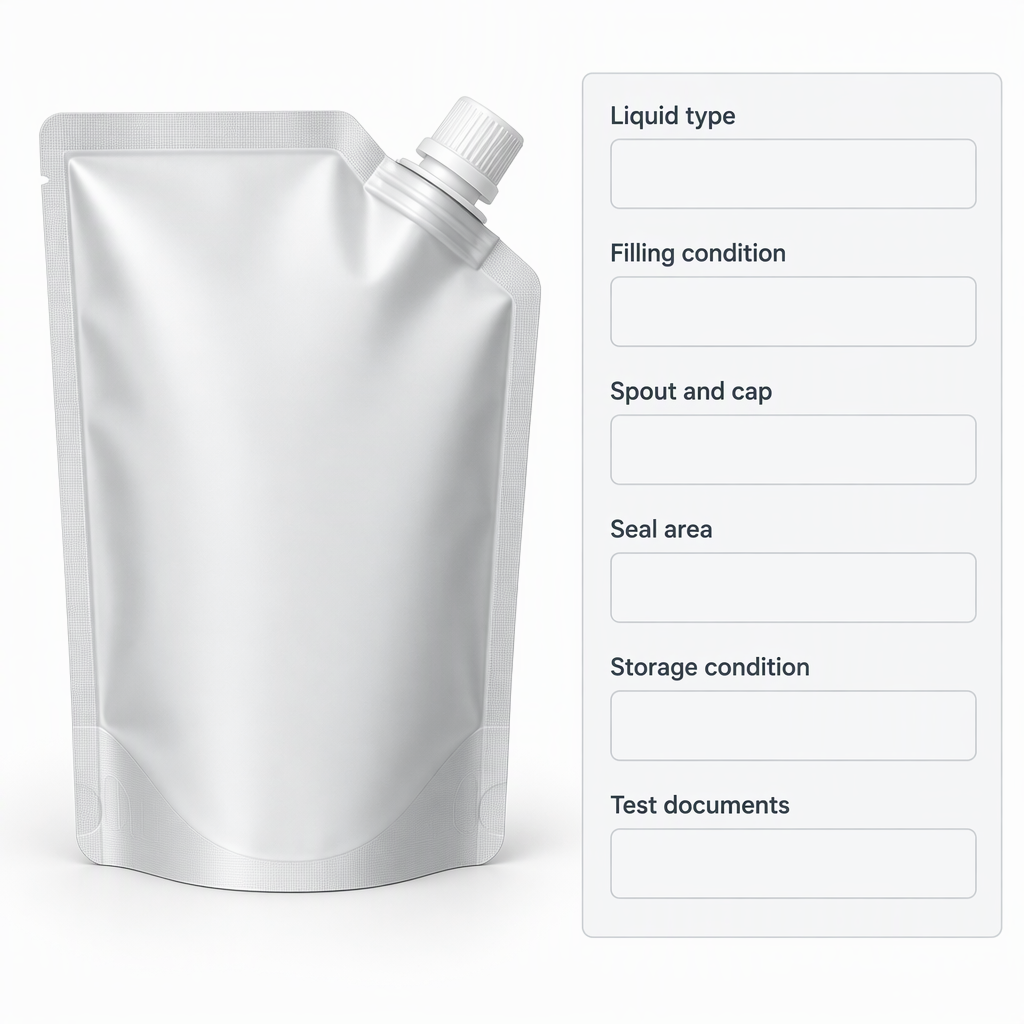
Start with the liquid, filling process, and dispensing use
The first specification step is to define the product type and use condition because food-contact evaluation uses both the food category and the intended condition of use. For non-food liquids, the same practical starting point helps suppliers understand chemical contact, filling stress and dispensing behavior.
- Define the liquid family: beverage, edible oil, sauce, detergent, refill liquid, concentrate or another product type.
- Record the filling and use condition, such as hot fill, pasteurization, room-temperature fill and storage, refrigerated storage, frozen storage or another defined condition used for food-contact evaluation.
- Describe viscosity, foaming tendency, particulates and whether the liquid may wet the seal or spout area during filling, shipping or dispensing.
- Specify the dispensing task: controlled pouring, squeeze dispensing, refill transfer, dosing, on-the-go drinking or repeated opening and closing.
- Separate must-have requirements from preferences, so suppliers can recommend a realistic structure instead of pricing a pouch that is more complex than the application requires.
For food and daily-chemical brands, this front-end definition prevents a common RFQ problem: asking for spout pouches for liquids without stating the contact liquid, filling temperature, storage chain, closure use and distribution stresses that shape the package design.
Match the pouch to liquid type and use conditions
Liquid type and use condition can change the packaging question because the FDA’s food-contact tables distinguish food categories and conditions such as heat sterilization, boiling-water sterilization, hot fill or pasteurization, room-temperature storage, refrigeration, freezing, irradiation and cooking above 250°F.
| Specification input | What to define before RFQ | Why it matters |
|---|---|---|
| Product identity | Food, beverage, oil, sauce, detergent, refill liquid or other liquid | Different liquids can create different contact, barrier, sealing and dispensing assumptions. |
| Thermal process | Hot fill, pasteurization, sterilization, room-temperature fill, chilled fill, frozen storage or another defined condition | For U.S. food-contact evaluation, the food type and condition of use matter; pouch format alone is not enough. |
| Storage and distribution | Ambient, refrigerated, frozen, e-commerce, bulk case pack or retail shelf | The pouch should be assessed against the handling and storage stresses expected before opening. |
| Use pattern | Single-use pour, repeated opening, squeeze use, refill transfer or dispensing into another container | Spout, cap, fitment and seal-area choices should match the way the pouch will be used. |
Choose material and barrier requirements without over-specifying
Material and barrier choices should be tied to the liquid and use condition rather than selected from a generic pouch description. The right RFQ asks suppliers to explain the structure they recommend and the assumptions behind it.
| Buyer question | Useful way to specify | Avoid over-specifying by |
|---|---|---|
| Does the product need oxygen, aroma, moisture or light protection? | Ask suppliers to recommend a structure and state the barrier basis for your product and shelf-life target. | Not demanding a named layer before product sensitivity and distribution are clear. |
| Will the liquid be hot-filled, chilled, frozen or stored at ambient temperature? | Tie the structure request to the food type and condition-of-use category where food-contact review applies. | Not assuming one film structure fits every thermal process. |
| Does the pouch need a spout, cap or larger refill format? | Describe how the user opens, dispenses, recloses and stores the pouch after opening. | Not selecting a spout only by diameter or appearance. |
| Is sustainability a project requirement? | State the target, such as recyclability review, material reduction or another documented design goal. | Not accepting unsupported environmental claims without structure, market and end-of-life documentation. |
Verify seal, spout, and leak performance with the right tests
Procurement should request seal-strength evidence where ASTM F88/F88M-23 is an appropriate reference for flexible barrier material seal strength. For filled packages that may face pressure or handling stress, ASTM F1140/F1140M-13(2025) identifies internal-pressurization failure resistance as a separate test-method subject.
| Evidence to request | What it can help show | Buyer note |
|---|---|---|
| Seal-strength test data | Seal-strength information for flexible barrier material seals | Ask which seals were tested, including side, bottom, top and fitment-area seals where relevant. |
| Internal-pressurization evidence | Failure resistance of an unrestrained package under the referenced test-method subject | Use it as part of package review, not as a substitute for filled-product trials. |
| Bubble-emission leak screening | Determination of leaks in flexible packaging by bubble emission | Confirm whether the method fits the actual pouch format and headspace condition. |
| Fitment and cap checks | Spout attachment, closure fit and repeated-use behavior | Ask for the supplier’s method and acceptance criteria for the actual spout and cap combination. |
Understand the limits of common pouch tests
ASTM F88/F88M-23, as identified by ASTM, addresses seal strength of flexible barrier materials. ASTM F1140/F1140M-13(2025) addresses internal pressurization failure resistance of unrestrained packages. ASTM D3078-02(2021)e1 addresses determination of leaks in flexible packaging by bubble emission.
Use testing as a decision system. Seal-strength evidence helps evaluate sealing control. Pressurization evidence helps review package resistance under the chosen method. Leak screening helps identify leakage risk under the selected method’s conditions. Before pilot approval, ask for sample conditioning, filled-product simulation, spout orientation, cap condition, headspace assumption and distribution scenario.
Treat food-contact and market compliance as application-specific
A supplier should not describe a liquid spout pouch as automatically food-contact compliant for every food and market because FDA food-contact resources are organized around food-contact substances and related regulatory information. The food type and condition of use also need to be defined for U.S. food-contact evaluation.
For daily-chemical liquids, food-contact rules may not be the controlling framework, but the same discipline is useful: define the liquid chemistry, contact time, filling temperature, storage, dispensing exposure and target selling markets before approving the pouch structure.
Build the RFQ checklist before comparing suppliers
Sunkey Packaging has an English liquid-packaging manufacturer and supplier page. For any supplier comparison, a strong RFQ should give enough information to recommend a pouch structure, spout and test plan rather than asking only for a unit price.
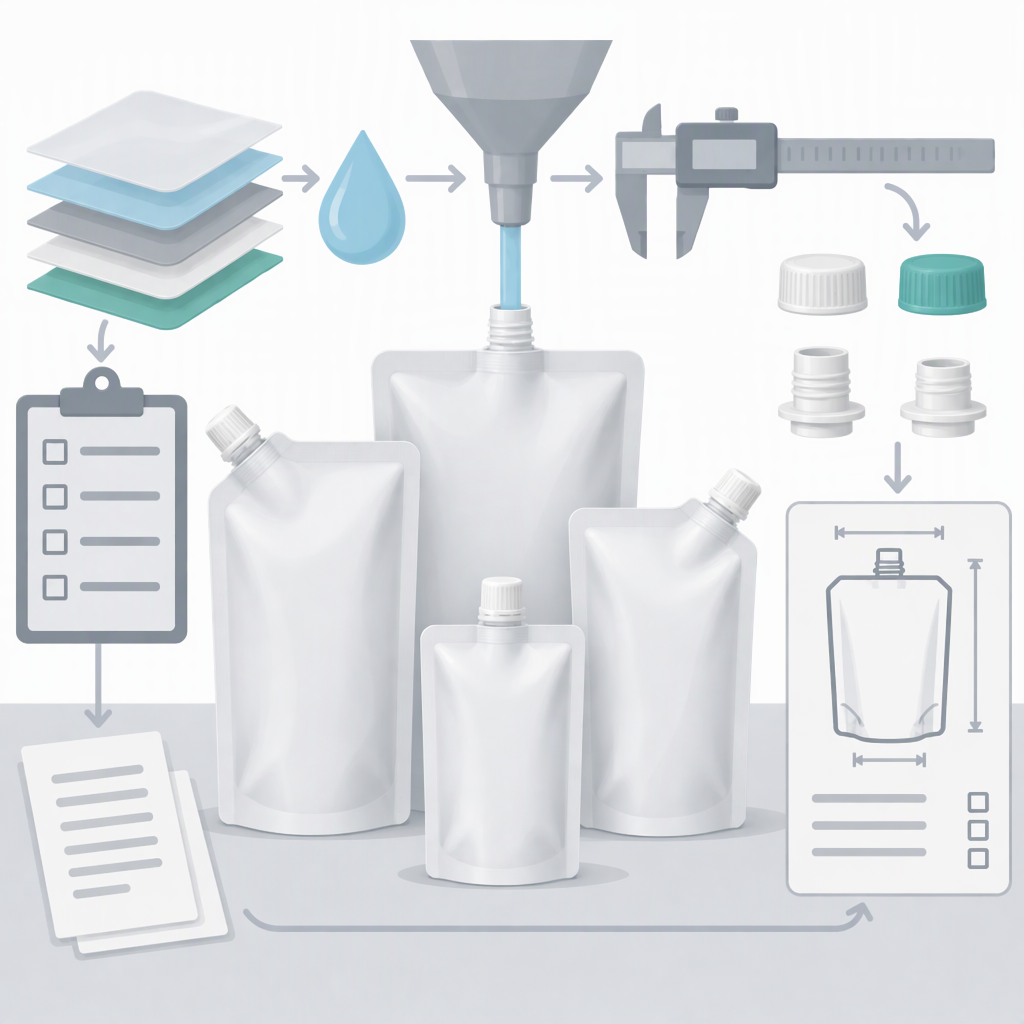
- Product description, liquid family, viscosity, particulates, foaming behavior and sensitivity to oxygen, aroma, moisture or light.
- Food type, thermal process, storage condition and intended condition of use where food-contact evaluation applies.
- Target fill volume, headspace expectation, pouch format, stand-up requirement, gusset needs and dispensing posture.
- Spout, cap and fitment expectations, including opening size, closure type, reclosure need and dispensing behavior.
- Seal-strength evidence requested for the relevant seal areas, not only a generic film sample.
- Internal-pressurization failure-resistance evidence when pressure resistance is relevant to distribution or handling.
- Leak-screening method and its applicability to the actual pouch, headspace and filled-product condition.
- Regulatory documents required for the target market, especially food-contact substance support for U.S. food applications.
- Artwork, filling-line constraints, pallet or carton assumptions, trial quantity and approval process.
Conclusion
The best specification is not the most complex pouch; it is the pouch whose liquid-contact conditions, filling process, dispensing use, test evidence and market documents match the product.
- Define the liquid, food category where relevant and condition of use before choosing material or spout details.
- Ask for seal-strength evidence that matches the relevant seal areas.
- Keep regulatory review application-specific and market-specific.
- Use a structured RFQ so suppliers explain assumptions before price comparison.
FAQs about spout pouches for liquids
These questions help food, daily-chemical, packaging R&D and procurement teams narrow the specification before supplier comparison.
What are spout pouches for liquids used for?
They are used when a flexible pouch must hold a liquid and dispense through a fitment or spout. Typical specification work should focus on the liquid, filling process, storage, distribution and dispensing use rather than the pouch name alone.
What information should I give a supplier first?
Start with the liquid type, fill volume, filling temperature, storage chain, dispensing use, target market and documents required for approval. That information lets the supplier recommend a structure and test plan instead of guessing.
Does hot fill change the specification?
Yes. FDA use-condition categories distinguish hot fill or pasteurization from room-temperature, refrigerated, frozen and higher-temperature conditions, so buyers should state the actual process before evaluating food-contact and material options.
Which tests should be requested for seal and leak review?
Ask for seal-strength evidence where ASTM F88/F88M-23 is relevant. Consider internal-pressurization failure-resistance evidence where that test subject matches the package risk. For leak review, confirm whether ASTM D3078-02(2021)e1 bubble-emission context fits the pouch and headspace condition.
Can one pouch structure cover every liquid?
No. Liquids differ in chemistry, aroma sensitivity, oxygen sensitivity, viscosity, filling process and dispensing behavior. Ask suppliers to link the proposed material and barrier assumptions to your product and use condition.
Is food-contact compliance automatic for a spout pouch?
No. U.S. FDA food-contact resources focus on food-contact substances and related regulatory information. The food type and condition of use must also be defined for the intended application.
How should procurement compare supplier quotes?
Compare quotes only after each supplier states the proposed material structure, spout and cap assumptions, test evidence, regulatory documents, trial conditions and exclusions. A low price is not comparable if the technical scope is incomplete.


