Call: +86-13812511247                  Email: bml@sunkeycn.com                    Join Us
Home » News » Flat-Bottom vs. Stand-Up Pouches: Which Format Fits Your Product and Filling Line?

Flat-Bottom vs. Stand-Up Pouches: Which Format Fits Your Product and Filling Line?

Views: 0     Author: Site Editor     Publish Time: 2026-11-16      Origin: Site

Inquire

facebook sharing button
twitter sharing button
line sharing button
wechat sharing button
linkedin sharing button
pinterest sharing button
whatsapp sharing button
kakao sharing button
snapchat sharing button
telegram sharing button
sharethis sharing button

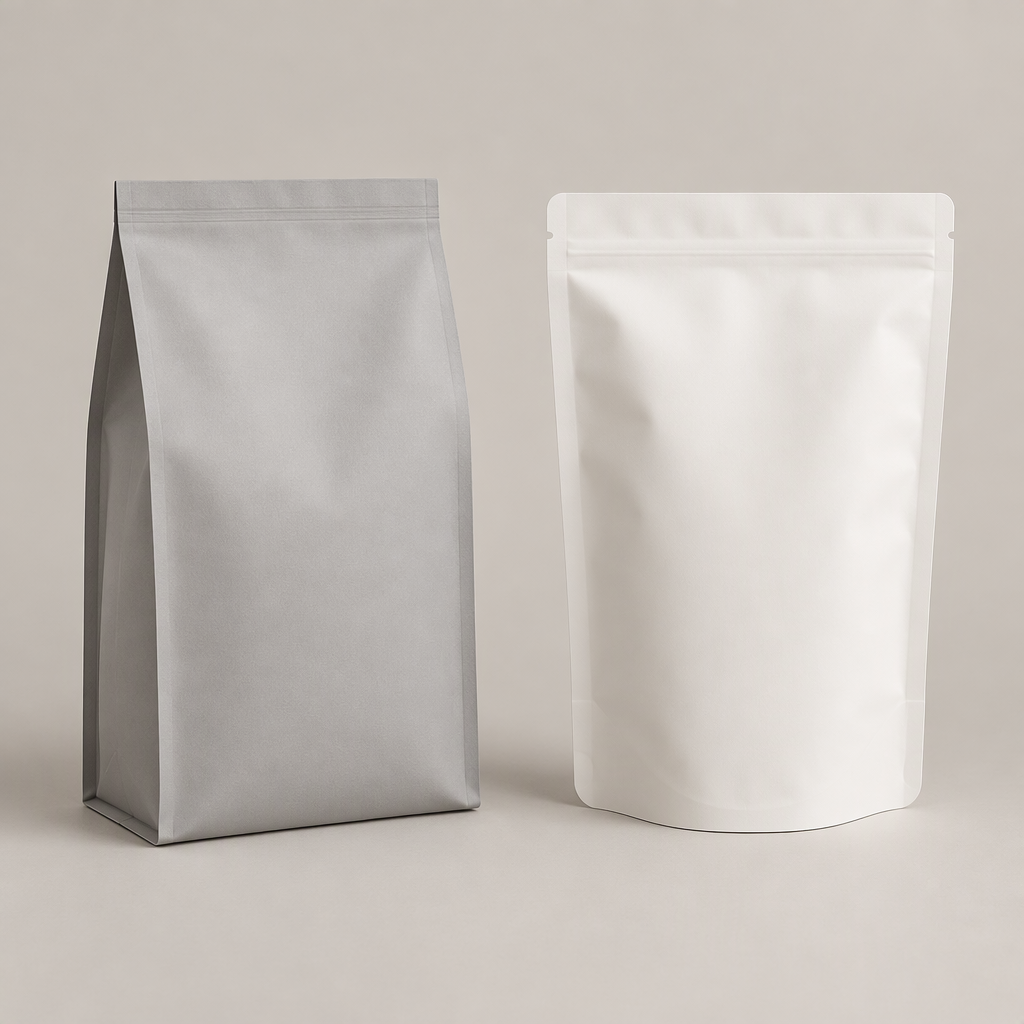
Side-by-side flat-bottom pouch and stand-up pouch silhouettes for packaging format selection

Structure difference: bottom gusset vs flat base

A stand-up pouch is built around front and back panels with a bottom gusset, while a flat-bottom pouch uses side gussets and a flat base that creates a more box-like structure.

Stand-up pouch

The defining feature is the bottom gusset, which lets the pouch stand when the packed product and pouch geometry support it.

For selection, check whether the base opens consistently after filling, whether the filled pouch stays upright through handling, and whether the front and back panels give enough space for the label hierarchy.

Flat-bottom pouch

The defining feature is the flat base with side gussets, giving the format a more box-like shape than a bottom-gusset stand-up pouch.

For selection, check whether the square base improves shelf alignment, whether the gussets hold the intended fill weight, and whether the extra panels are useful for branding, ingredients, or instructions.

Selection point Stand-up pouch Flat-bottom pouch
Base structure Bottom gusset with front and back panels Flat base with side gussets and box-like structure
Best way to evaluate Run filled samples at the target fill weight and closure style. Run filled samples at the same fill weight, closure style, and shelf orientation.
Decision boundary Do not assume shelf behavior from empty samples alone. Do not assume the added structure is worth the cost without a line and shelf trial.

Shelf and branding fit under the same fill condition

Compare shelf and branding fit only after both formats are filled to the same target weight, with the same product flow behavior and closure, because pouch shape alone does not prove finished-pack stability.

When the stand-up format may be enough

Because the stand-up pouch uses a bottom gusset, it can be a practical route when the filled product supports the base and the front and back panels carry the required selling information.

It is often worth testing first when the brand wants a flexible pack with fewer display panels, a familiar retail silhouette, or a trial structure before moving to a more box-like pouch.

When the flat-bottom format deserves a trial

Because the flat-bottom pouch uses side gussets and a flat base, it can be considered when the project values a squared shelf footprint and multiple printable surfaces.

It is especially important to test with the real product because powders, granules, flakes, viscous products, and wipes can settle differently inside the same nominal pouch size.

Product-fit decision table for food and daily-chemical packs

Use product behavior to narrow the format: free-flowing, dusty, oily, oxygen-sensitive, moisture-sensitive, refill, and squeeze-use products put different stress on the base, seal, barrier, and opening features.

Product condition Stand-up pouch screening question Flat-bottom pouch screening question Buyer action
Snacks, granules, pet treats, or dry food Does the bottom gusset open cleanly and stand after vibration and settling? Does the flat base improve shelf blocking or case packing enough to justify the structure? Fill both formats to the same weight and compare shelf facing, headspace, and handling.
Coffee, powder, or aroma-sensitive dry goods Can the chosen laminate, closure, and seal layout meet aroma and moisture targets? Does the multi-panel format help with valve, zipper, label, or information placement? Separate format selection from barrier selection, then test the final laminate.
Liquid, gel, refill, or daily-chemical product Does the base remain stable after filling, capping, spout insertion, or squeeze handling? Does the flat base remain useful once the product shifts during use? Run leak, drop, cap/closure, and use-position trials with the exact formula.
High-value retail product Is the main front panel sufficient for the brand and compliance copy? Are side panels valuable for instructions, ingredients, or multilingual copy? Review artwork hierarchy on filled samples, not on dielines alone.

Filling-line checks before changing pouch format

The right pouch is the one your line can open, fill, de-aerate, seal, code, inspect, and case-pack repeatably at the target product condition; confirm this with your machine supplier and a controlled line trial.

  1. Confirm pouch magazine or infeed handling for the target width, height, gusset, zipper, spout, tear notch, and hanging or display feature.
  2. Run opening and filling trials using the real product, including dust, foam, static, oil, viscosity, particle size, or product bridging concerns.
  3. Check whether the bottom or side gussets interfere with filling jaws, guides, conveyors, coders, checkweighers, metal detectors, or vision inspection.
  4. Set sealing parameters only within the material supplier’s and machine supplier’s recommended window, then confirm seal appearance and package integrity.
  5. Pack finished samples into the intended shipper and retail display orientation to identify bulging, leaning, abrasion, or label-readability problems.
  • Ask for sample pouches made to the proposed structure, not just a similar stock sample.
  • Record fill weight, temperature at filling, product density, headspace, closure type, and seal area contamination risk.
  • For any manual access to powered filling, sealing, or inspection equipment during trials, switch off and disconnect the applicable power source before reaching into guarded or moving areas, and follow the equipment manual’s permitted access procedure.

Material, barrier, and seal checks that matter in both formats

Do not let pouch shape hide the material decision: oxygen barrier, moisture barrier, puncture resistance, stiffness, sealant choice, and closure design must be specified and tested for the product and market.

ASTM F1249-25 covers water vapor transmission rate testing for flexible barrier materials including plastic films, multilayer polymers, foils, and coated materials up to 3 mm thick. ASTM D3985-24 covers steady-state oxygen transmission rate testing through plastic film, sheeting, laminates, coextrusions, and coated papers or fabrics using a coulometric sensor.

  • For moisture-sensitive foods, powders, detergents, wipes, or refill products, request water-vapor barrier data for the proposed laminate and thickness rather than assuming either format is automatically protective.
  • For oxygen-sensitive products such as coffee, nuts, nutrition powders, or fragrance-sensitive daily chemicals, request oxygen-barrier data for the exact material structure.
  • Compare sealant layer compatibility with filling temperature, product contamination at the seal area, closure style, and expected consumer opening and reclosing behavior.
  • Confirm whether stiffness needed for shelf presentation conflicts with squeeze, pour, refill, or disposal expectations.

Cost drivers without assuming a universal cheaper option

There is no responsible universal answer to which format is cheaper; compare the full quoted structure, converting process, filling efficiency, scrap risk, logistics fit, and validation cost for the same product and order scenario.

Cost driver What to compare Why it changes the decision
Material structure Film layers, barrier layer, stiffness, sealant, print surface, zipper, valve, spout, or handle. A simpler shape with a complex laminate may cost more than a more structured pouch with a simpler laminate.
Conversion and finishing Gusset complexity, bottom formation, closure insertion, print registration, and special cuts. Extra panels and features can affect tooling, waste, and inspection requirements.
Filling-line performance Line speed, rejects, seal contamination, downtime for changeover, and case-packing fit. A lower pouch price can be lost if the line runs poorly or requires frequent adjustment.
Distribution and retail Carton count, shelf-facing count, pack damage, display orientation, and returned goods risk. The format should be evaluated through the whole route to shelf, not only by unit pouch price.

Regulatory and validation checks before launch

Before launch, treat regulatory status, food-contact suitability, barrier performance, seal performance, and gross-leak screening as project-specific checks that must match the intended product, market, and package structure.

For U.S. food-packaging context, the FDA food contact substance notification guidance explains that food contact substances are components of materials used in manufacturing, packing, packaging, transporting, or holding food, and that the guidance reflects FDA’s current thinking rather than creating binding requirements unless specific statutory or regulatory requirements apply.

ASTM F2096-11(2019) is an active test method for detecting gross leaks in packaging by internal pressurization bubble testing; the ASTM page states that it may be used for tray and pouch packages and that it is destructive because the package must be entered to supply internal air pressure.

  • For food packs, request current food-contact documentation for the intended market and product category; do not treat a general material name as proof of suitability.
  • For moisture-sensitive products, include a WVTR method such as ASTM F1249-25 when it matches the material and test need.
  • For oxygen-sensitive products, include an OTR method such as ASTM D3985-24 when it matches the material and test need.
  • For package-integrity screening, discuss whether an ASTM F2096-11(2019) gross-leak bubble test is appropriate for the sample, knowing it is destructive.
  • Confirm local regulatory obligations, customer standards, and retailer requirements before approving packaging for sale.

Pilot-test checklist for a defensible format decision

A defensible format decision comes from a side-by-side pilot: same product, same fill target, same material intent, same closure, same distribution assumptions, and documented results for standing, sealing, barrier, filling, and user handling.

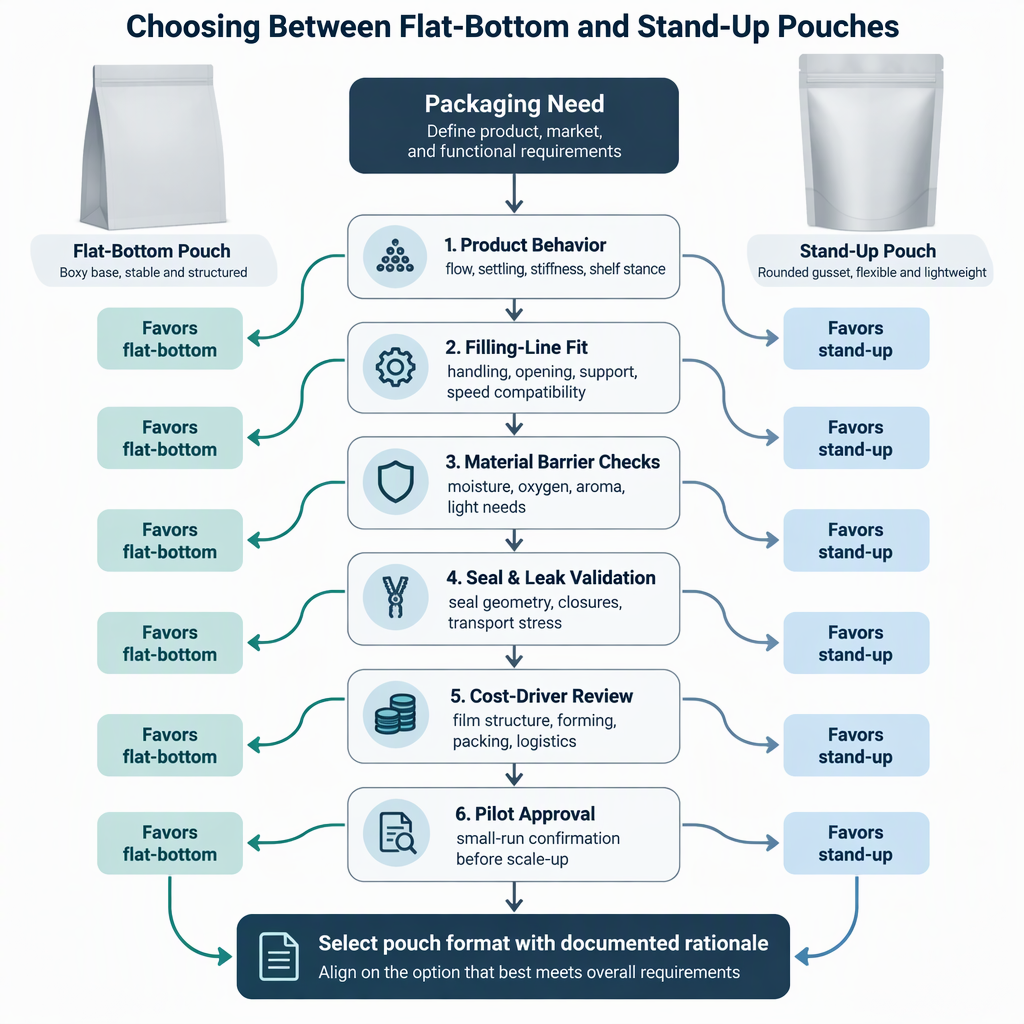
Qualitative decision flow from product behavior to line fit, barrier checks, seal validation, and pilot approval
  1. Define the required pack job: product type, fill weight, headspace, shelf life target, market, closure, retail orientation, and shipping route.
  2. Build comparable flat-bottom and stand-up pouch samples using the correct structural difference: side-gusset flat base for the flat-bottom pouch and bottom gusset for the stand-up pouch.
  3. Run line trials for opening, filling, de-aeration, seal contamination, coding, inspection, case packing, and operator handling.
  4. Test moisture-barrier performance when WVTR is critical to the product.
  5. Test oxygen-barrier performance when OTR is critical to aroma, oxidation, color, or active ingredients.
  6. Screen finished samples for gross leaks with an appropriate package-integrity method, such as ASTM F2096-11(2019), when it fits the package and validation plan.
  7. Review consumer use: opening force, reclosing, pouring, squeezing, storage, residue, disposal, and label readability after use.
  • Approve the format only after filled samples pass the same acceptance criteria.
  • Document test conditions so later artwork, laminate, zipper, or machine changes can be assessed against the original decision.
  • Keep a retained sample set from the approved trial for future comparison.

Conclusion

Choose the format that performs best in your filled, sealed, shipped, displayed, and used condition—not the format that sounds better in isolation.

Flat-bottom pouches and stand-up pouches differ structurally, so they create different shelf, panel, and handling possibilities. The final decision should combine that structure with line trials, material-barrier checks, seal and leak validation, regulatory review for the intended market, and a full cost comparison based on the same specification.

Frequently asked questions

These buyer questions help turn a flat bottom pouch vs stand up pouch comparison into a testable specification.

Which pouch stands better on shelf?

A flat-bottom pouch has a flat base with side gussets, while a stand-up pouch uses a bottom gusset, so the shelf result must be checked with the filled product rather than inferred from empty samples.

Which format is better for coffee or aroma-sensitive products?

The format is only part of the answer. For coffee and aroma-sensitive products, compare the laminate, closure, valve or zipper needs, headspace, and barrier targets before choosing the shape.

Does pouch shape determine oxygen or moisture barrier?

Moisture barrier should be checked with an appropriate WVTR method when it matters. Oxygen barrier should be checked with an appropriate OTR method when oxygen exposure matters. Shape does not replace material testing.

Which format fits automatic filling equipment better?

Neither format should be assumed to fit automatically. Confirm pouch infeed, opening, filling, seal jaw clearance, coding, inspection, and case packing with the equipment supplier and a real line trial.

Is a flat-bottom pouch always more expensive?

No single answer is reliable without a matched quote. Compare material, converting, closure, printing, line performance, scrap, logistics, and validation cost under the same pack specification.

What tests should be done before switching formats?

Package-integrity testing may include a gross-leak method such as ASTM F2096-11(2019) when it fits the pouch and validation plan. Add filling trials, shelf checks, shipper checks, barrier tests, seal checks, and consumer-use checks.

Do food pouches need food-contact review?

For U.S. context, FDA guidance treats food contact substances as components of materials used in manufacturing, packing, packaging, transporting, or holding food. Confirm the current rules for the intended market and product category.

Can one sample decide the format?

One sample can reveal issues, but approval should be based on multiple filled samples made to the proposed material, size, closure, and artwork assumptions, then tested against the same acceptance criteria.

Table of Content list

Find Your Perfect Packaging Solution

Select your packaging needs by filtering through our comprehensive categories. If you don't find what you're looking for, feel free to contact us for custom solutions.
Select Primary Category Select Primary Category
  • Sustainable Packaging
    • Single Layer

        No classification

    • Mono Material/ Recyclable

        No classification

    • Biodegradable Packaging

        No classification

  • Functional Packaging
    • High Barrier

        No classification

    • Temperature Resistance

        No classification

    • Active Packaging

        No classification

    • High Tenacity

        No classification

  • Consumer Experience Packaging
    • Shelf Attraction

        No classification

    • Easy Tear

        No classification

    • Easy Peel

        No classification

  • Food Packaging
    • Fruits And Vegetables

        No classification

    • Fresh & Frozen Foods

        No classification

    • Heated Products

        No classification

    • Soy & Dairy Products

        No classification

    • Pet Food Packaging

        No classification

    • Liquid Packaging

        No classification

    • Snacks

        No classification

  • Pharmaceutical Packaging
    • Medical Packaging

        No classification

    • Medical Devices Packaging

        No classification

  • Daily Chemical Packaging
    • Personal Care

        No classification

    • Household packaging

        No classification

  • Industrial Packaging
    • Transport Packaging

        No classification

    • Chemical products

        No classification

    • New Energy Packaging

        No classification

Please select

    Please select superior classification

Please select

    Please select superior classification

Please select

    Please select superior classification

Please select

    Please select superior classification

If you can't find the product you're looking for, please feel free to contact us. 

Products You Might Find Useful

Discover products that complement this article and enhance your experience.
Call: +86-13812511247            Email: bml@sunkeycn.com

LINK

PRODUCTS

SOLUTION

ABOUT US

Sign Up To our Newsletters

Leave a Message
Contact us
Copyright © 2026 Sunkey Packaging Co., Ltd.                         Privacy Policy