


Pick the format from the product and the process, not from the shelf. Dry, wet and treat-style packs fail in different ways, so the film, closure and documentation follow from your own product and process data.
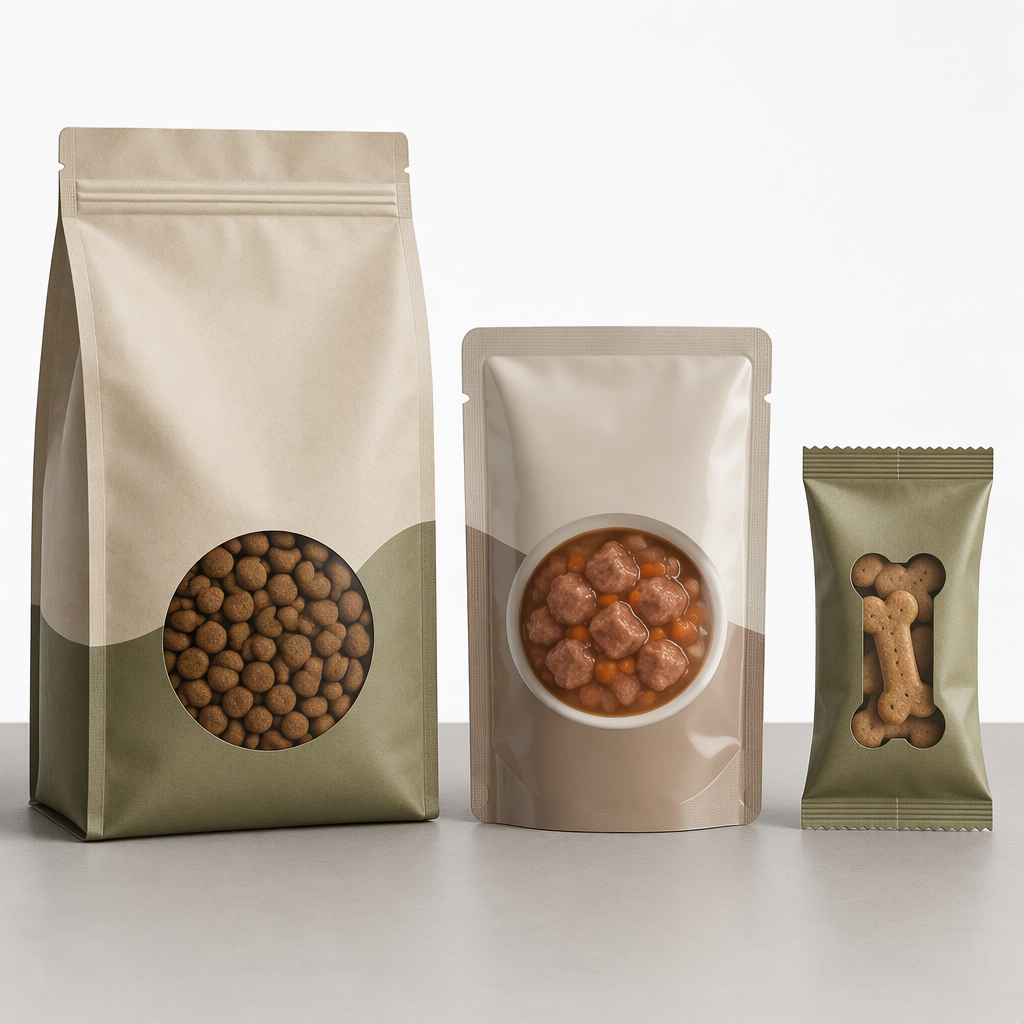
What changes between dry, wet and treat-style pet food packaging?
Three things change. Dry food has to keep its texture and aroma and survive stacking and reopening. Wet food is a hermetically sealed pack whose contents must be processed in conformance with the low-acid canned food regulations in 21 CFR 113, as FDA states for canned pet food. Treat-style products sit between the two, decided mainly by moisture, fat and how often the pack is opened.
| Decision area | Dry kibble | Hermetically sealed wet food | Treat-style |
|---|---|---|---|
| Main protection question | Keep the product crisp, hold aroma, limit moisture and oxygen movement | Keep the contents commercially sterile after the declared process | Hold texture and aroma through open-and-close use |
| Closure | Reclose feature for multi-serve packs | Hermetic seal, with no reclose expectation | Single-serve pack, or reclosable for larger treats |
| Process the pack must survive | Filling, stacking and distribution | The declared thermal process, then cooling | Filling and ambient distribution |
| Declare first | Fill weight, reclose need, stacking height | Product and process conditions, and the market | Moisture, fat and servings per pack |
Moisture, fat, process conditions and acceptable leakage come from your own product, so treat any structure offered before those numbers exist as a trial starting point.
How should you specify a bag for dry kibble?
Specify a dry kibble pack by its job: hold aroma, limit moisture and oxygen movement to a level your own storage trial sets, survive stacking and handling, and reclose reliably if the pack is multi-serve. Formats in common use are pillow and side-gusset bags, flat-bottom pouches and stand-up pouches.
Sunkey Packaging states that it runs an in-house chain covering film making, printing, laminating, slitting and bag making, and lists stand-up pouches and flat bottom bags among the pet food packaging applications it serves.
- Fill weight, finished pack dimensions and the format your line can run.
- Whether the pack must reclose, and how many times it is reopened.
- The moisture, oxygen and aroma limits you need, set by your own storage trial.
- Fat and oil level, which shape the food-contact layer.
- Stacking height, pallet pattern and the drops the filled pack must survive.
- Fill method, fill temperature and line speed.
A structure that worked for a different fill weight, oil level or temperature is only a starting point.
What does hermetically sealed wet pet food packaging require?
Wet packs are a process question first. FDA states that canned pet foods must be processed in conformance with the low-acid canned food regulations in 21 CFR 113. The pack, the sealer and the process conditions must be validated together.
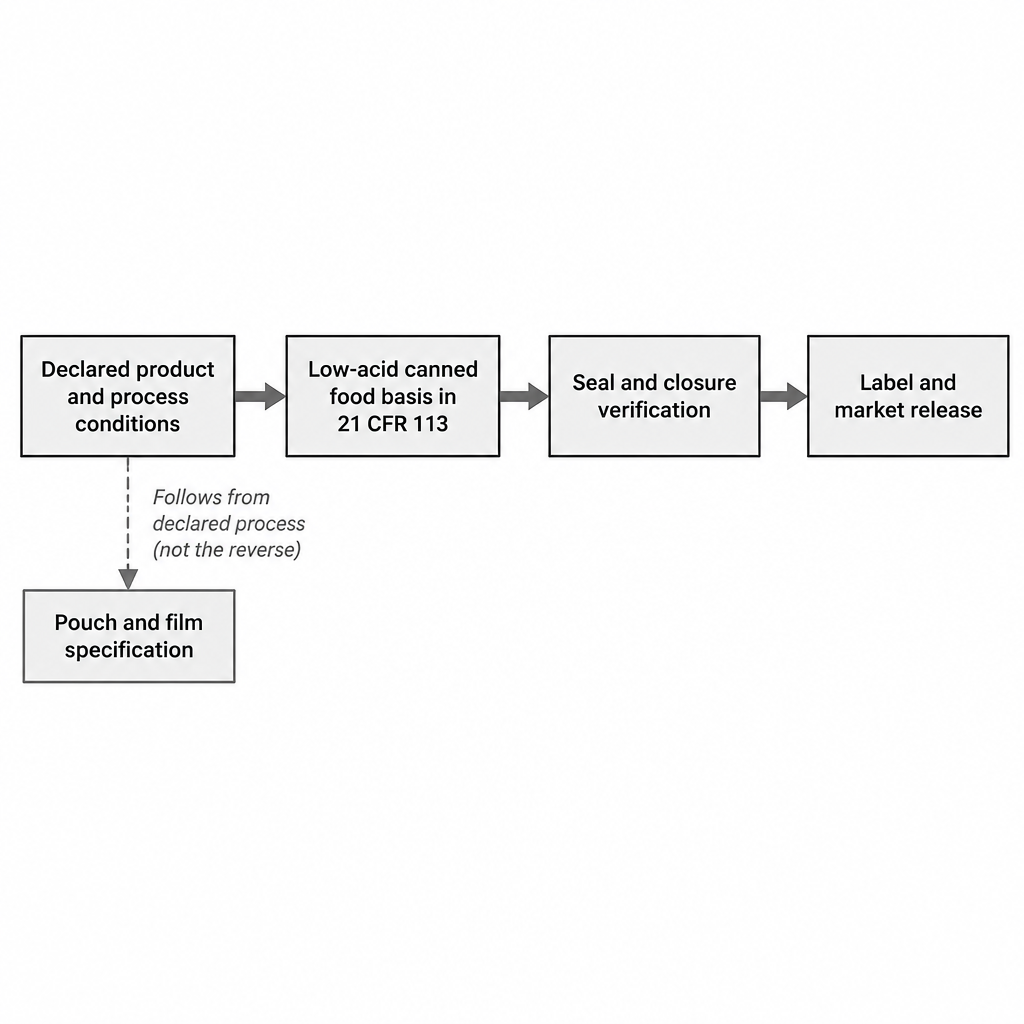
- Write down the product basis, pack size, filling temperature, your thermal process conditions, cooling, handling and the market you sell in.
- Ask for a structure intended for that process rather than for a film by name.
- Fix format, seal geometry and opening feature together, then check the food-contact status of every layer that touches food.
- Confirm the seal-integrity method and acceptance criteria in writing, and verify them on your own line.
- Release artwork and the market only after that validation.
Your declared process, not the pack's description, drives the film and seal validation. If the product sits near a boundary, get a written position from the converter and confirm the rules for your market.
FDA's pet food page states the 21 CFR 113 requirement for canned pet food alongside the general rule that animal food must be safe, produced under sanitary conditions, free of harmful substances and truthfully labelled: Pet Food, U.S. Food and Drug Administration.
How is treat-style and semi-moist packaging specified differently?
Treat packs are specified by moisture, fat and how the pack is used. A moist treat moves water and aroma differently from a dry biscuit, so the questions become whether the pack holds texture and smell through reopening, and whether the film suits a fatty product.
Semi-moist and soft treats
Pack: limit moisture movement while the pack is open and closed.
Closure: does the reclose feature still work with fat or crumbs in the seal area?
Send with the enquiry: moisture or water activity, fat level, servings per pack.
Dry biscuits and baked treats
Pack: keep the product crisp and unbroken through the distribution you use.
Closure: single-serve, or reclosable for a pack that lasts several days?
Send with the enquiry: fill weight, packs per carton, stacking and drop conditions.
Strips and higher-fat treats
Pack: suit a fatty, oily product at the food-contact layer.
Closure: is the opening sized for the piece, and does it hold after repeated use?
Send with the enquiry: fat and oil level, surface texture, fill temperature.
A structure validated for one treat's moisture and fat level may not protect another, so ask what product data the proposal was validated against.
Which material and barrier questions decide the structure?
The laminate follows from the job the pack has to do, so your questions concern the product, the process and the market rather than film names. Supply those and the converter returns a structure with measured transmission and seal values.
| What you supply | What comes back | Why it changes the structure |
|---|---|---|
| Product form, moisture, fat, aroma sensitivity | A structure with a stated reason for each layer | Layers and coatings answer different product risks |
| Filling temperature, thermal process, cooling, distribution | Confirmation that the structure suits those conditions | Film and seals must survive the process, not only the shelf |
| Shelf-life and storage target, distribution | Expected transmission values and how they were measured | Shelf life is set by your own product-and-pack trial |
| Pack size, format, reclose feature, stacking | Seal and stiffness recommendations, plus samples for line trials | Geometry and load drive the seal area and film rigidity |
| Line type, speeds, filling method | Recommended sealing conditions and the tolerance around them | The film has to run on the machine you own |
| Markets and documentation needs | A declaration naming the laminate and the site that makes it | Markets ask for different paperwork for the same film |
A material decision does not change the underlying rule: pet food must be safe, produced under sanitary conditions, free of harmful substances and truthfully labelled.
Every food-contact layer also has to sit inside an authorized pathway for your market, which is separate from how well the film performs.
How do fill, seal and pack-line conditions constrain the film?
Your line, not the film's data sheet, decides whether a structure works. Filling temperature, dosing, product dust or fat in the seal area, sealer type, dwell, pressure and line speed all constrain the film and the seal geometry, so send them with the enquiry.
- Sealer type: form-fill-seal or pre-made pouch line, with jaw width and pattern.
- The sealing window your machine holds on a running line: temperature, dwell and pressure.
- Fill method and fill temperature, and how the product reaches the pack.
- How much dust or fat reaches the seal area, and how the line keeps it out.
- Line speed, number of lanes and changeovers between products.
- What happens after sealing: cooling, stacking, case packing, palletising and drop heights.
Ask the converter to state the seal-integrity method, the number of samples and the pass limit it applies, and to confirm them on your own line trial. A structure tested at another site is not validated for yours.
How do you verify food-contact compliance before approving artwork?
Run food-contact compliance as a document check before artwork. In the US, FDA's food contact framework covers notifications, threshold-of-regulation exemptions, 21 CFR listings and recycled plastics. In the EU, materials must comply with framework Regulation (EC) No 1935/2004 and be manufactured under the Good Manufacturing Practice Regulation (EC) No 2023/2006, plus material-specific measures such as the plastics rules and national rules. Ask for a declaration naming the laminate, the relevant substances and the site that makes it.
- A declaration covering the actual laminate and the site that makes it, with version and date.
- The food-contact status of every layer, ink and adhesive that touches food, with its reference.
- Whether recycled plastic is used, and on what basis.
- Whether plasticizers such as phthalates are present: FDA authorizes nine phthalates for food contact applications and revoked 23 authorizations in 2022, so an earlier statement proves nothing about today's position.
- For EU sales, confirmation of the framework and GMP Regulations, the plastics measure and any national rules.
- The migration or extraction testing relied on, who holds the reports, and who signs the declaration.
FDA publishes the notifications, 21 CFR listings, threshold-of-regulation exemptions and its position on recycled plastics, so a converter's reference can be checked against the regulator's lists: Packaging and Food Contact Substances, U.S. Food and Drug Administration.
The same check has to be repeated over time, because authorizations change: Phthalates in Food Packaging and Food Contact Applications, U.S. Food and Drug Administration explains that nine phthalates remain authorized, 23 were revoked in 2022, and the rest stay under review.
A formulation change, a new supplier or a different plant needs a new statement before the pack is printed.
A compliance statement is not a performance claim: it says nothing about how long your product keeps or how the seal runs on your line, both of which your own trials decide.
What should you send a converter in a pet food packaging RFQ?
Send one document with the product data, the process data and the commercial frame, and ask the converter to answer in the same order. A quotation built without the process and line data is a film price, not a pack specification.
- Product: form, fill weight, moisture or water activity, fat level, aroma sensitivity and any declarations you must carry.
- Process: filling temperature, thermal process conditions or none, cooling, and ambient or chilled distribution.
- Pack: format, finished dimensions, closure, stacking height and expected drops.
- Line: sealer type, achievable sealing window, fill method, speeds and lanes.
- Markets: countries of sale, food-contact documents required, recycled-content or recyclability questions, and who approves the label.
- Commercial: volumes, product life, artwork, samples, trials, and who signs the specification.
A converter with its own laboratory can report measured values such as oxygen and water vapour transmission rates with the method used. Sunkey Packaging states that it holds GRS and BRC certification and operates such a laboratory; confirm the certificate scope.
Conclusion
Choose the family first, then let the format, laminate, closure and documentation follow from the data you can supply.
Dry food is a moisture, aroma and stacking conversation. Hermetically sealed wet food is a process conversation, anchored in the low-acid canned food basis in 21 CFR 113 that your process authority applies to your product.
In all three cases, three documents decide whether a quotation is usable: product and process data, a declaration for every food-contact layer, and sealing conditions for your line.
Frequently asked questions about pet food flexible packaging
The same questions come up whichever format you are choosing: what the rules actually require, which document proves it, and which number only your own trial can set.
Does FDA require a particular pouch structure for pet food?
No. FDA's requirements address the food itself, which must be safe, produced under sanitary conditions, free of harmful substances and truthfully labelled, and its food-contact rules address the substances that may contact food, not a named pouch design. Choosing the structure is your decision, supported by the converter's data and your own trials.
Do wet pouches fall under the low-acid canned food regulations?
FDA states that canned pet foods must be processed in conformance with the low-acid canned food regulations in 21 CFR 113 so the food is free of viable microorganisms. Whether your hermetically sealed pouch is treated the same way depends on your product and process, so confirm the position for your format with your process authority, the converter and the regulator before you build artwork around it.
What changes if the same pouch is sold in the EU?
You need the EU set as well as the US set. EU food contact materials must comply with Regulation (EC) No 1935/2004 and Good Manufacturing Practice, with material-specific rules such as the plastics measure and national rules on top. Ask for a declaration naming the laminate, the substances that matter for your product and the site that makes it, and re-verify it if any of those change.
Should I ask about plasticizers and other additives in the film?
Yes, and ask again at artwork approval. FDA authorizes nine phthalates in food contact applications, revoked 23 authorizations in 2022, and continues to review those that remain, so an authorization statement from an earlier project is not proof of today's position.
Who approves the pet food label that goes on the pack?
In the US, pet food labelling is regulated at federal level, and some states also enforce their own rules, many of them based on an AAFCO model. Your converter prints what you approve; the label content and any state registration stay with you as the brand owner, so confirm current requirements for each market before the print file is released.
Can I specify recycled content or a mono-material film?
You can put both on the enquiry, but they need evidence before they enter the specification. Recycled plastics get separate consideration under FDA's food contact framework, and a simpler film still has to protect your product. Ask what testing supports the proposed structure.


