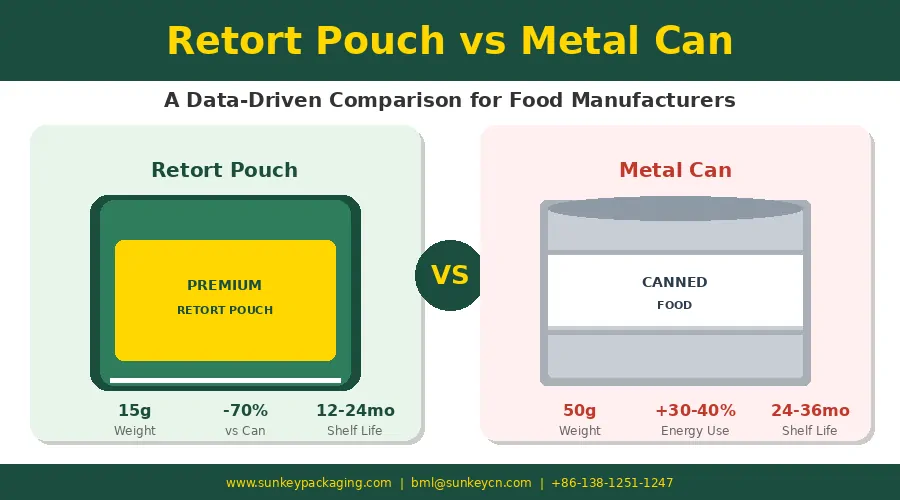
For most modern food manufacturing applications, retort pouches outperform metal cans on 6 out of 7 key metrics:
- Weight: 70% lighter (15g vs 50g per unit)
- Storage: 80% less space for empty packaging
- Processing: 42-60% faster retort cycles
- Energy: 30-40% lower consumption
- CO2 Emissions: 60% reduction vs metal cans
- Flavor & Nutrition: Superior retention
Metal cans retain the edge in one area: maximum shelf life (24-36 months vs 12-24 months).
The critical insight: calculate Total Cost of Ownership (TCO), not just unit price.
Table of Contents
1. The Core Question: TCO vs Unit Price
2. Side-by-Side: 7-Dimension Comparison
3. Cost Economics Deep Dive
4. Quality & Food Safety Comparison
5. Operational Considerations
6. Sustainability & ESG Impact
7. When Metal Cans Still Win
8. Making Your Decision
9. FAQ
1. The Core Question: TCO vs Unit Price
When food manufacturers evaluate packaging options, the instinct is often to compare the per-unit cost of retort pouches against metal cans. This is the wrong starting point.
A retort pouch may cost 15-30% more per unit than an equivalent metal can. But once you account for the full supply chain—from empty packaging logistics through to retail shelf—the picture changes dramatically.
Total Cost of Ownership (TCO) encompasses every cost associated with your packaging decision: material cost, storage of empty packaging, filling line efficiency, sterilization energy, transport weight, and retail logistics. When all factors are included, retort pouches frequently deliver a lower TCO than metal cans—even with a higher unit price.
Pro Tip: Ask your packaging supplier for a complete TCO model before making the switch. At Sunkey, we provide free TCO analysis for qualified projects—contact us at bml@sunkeycn.com.
The packaging industry's shift toward retort pouches is not driven by aesthetics alone. It is driven by math—and the numbers consistently favor flexible packaging across most product categories.
2. Side-by-Side: 7-Dimension Comparison
The following comparison evaluates retort pouches and metal cans across the seven dimensions that matter most to food manufacturers:
Dimension
Retort Pouch
Metal Can
Advantage
Package Weight
~15g per unit
~50g per unit
POUCH (-70%)
Empty Storage Space
Ships flat, ~80% less volume
Pre-formed, significant volume
POUCH
Processing Time
3–30 minute retort cycle
30–90 minute retort cycle
POUCH (-42-60%)
Energy Consumption
Base reference
+30–40% higher energy use
POUCH
CO2 Emissions
Base reference
+60% higher per unit shipped
POUCH (-60%)
Flavor & Nutrition
Superior (shorter heat exposure)
Good (industry standard)
POUCH
Maximum Shelf Life
12–24 months (room temp)
24–36 months (room temp)
CAN
3. Cost Economics Deep Dive
Cost is the decisive factor for most packaging transitions. Here is how the economics break down across each component of the supply chain:
3.1 Package Weight: The Logistics Multiplier
A typical retort pouch weighs approximately 15g. An equivalent metal can weighs 50g. This 70% weight reduction compounds across the entire supply chain:
- A pallet of 2,000 cans adds 100kg of packaging dead weight
- The same pallet in pouches adds only 30kg
- At scale of 1 million units/month, this is 70 tonnes of monthly logistics savings
- For international shipping, this translates directly to freight cost reduction
3.2 Empty Packaging Storage
Metal cans arrive at the filling facility as pre-formed rigid containers. They require significant warehouse space before filling. Retort pouches ship flat—a pallet of pouches occupies roughly 80% less warehouse space than an equivalent number of cans.
For high-volume operations, this storage advantage can reduce warehouse requirements significantly or allow higher inventory turns in the same footprint.
Storage Comparison
Retort Pouches
Metal Cans
Shipping format
Flat rolls or flat-packed
Pre-formed (full volume)
Warehouse space (per 100K units)
~12 pallet spaces
~60 pallet spaces
Space reduction
—
+400% more space needed
Damage in storage
Very low (flexible)
Low (but dents = defects)
3.3 Processing Time & Energy
Retort processing time for flexible pouches is significantly shorter than for metal cans of equivalent volume. This is because the pouch's thin cross-section allows faster heat penetration:
- Heat penetration to the slowest-heating point is faster in pouches (thin flat geometry)
- Shorter retort cycles mean higher throughput on the same equipment
- Energy consumed per batch is 30-40% lower with pouches
- Steam and water consumption in the retort vessel is also reduced
Pro Tip: If you are operating an existing retort vessel at less than 85% capacity, converting to pouches can increase your throughput without capital investment in additional equipment.
Processing Parameter
Retort Pouches
Metal Cans (equiv. volume)
Typical retort cycle time
15–30 minutes
45–90 minutes
Heat penetration rate
Fast (thin geometry)
Slower (radial through metal)
Energy per 1,000 units
Base reference
+30-40% higher
Water usage (cooling)
Base reference
+15-25% higher
Throughput per hour
Higher
Lower
4. Quality & Food Safety Comparison
Beyond cost, quality preservation is the second major decision factor. Contrary to a common assumption, retort pouches often deliver superior product quality compared to cans—precisely because of their faster heat penetration:
No metal taste migration; sealed immediately after fill
Color & Texture
Better
Less heat damage; product retains natural appearance
Aroma Retention
Better
Tighter seal prevents volatile compound loss
Food Safety
Equivalent
Both achieve commercial sterility (F0 > 3 minutes)
Microwave Convenience
Advantage
Many retort pouches can go directly in microwave
Consumer Perception
Premium
Pouches signal freshness; cans signal 'shelf stable'
Important: Note: The quality advantages of retort pouches depend on proper process validation. Incorrect F-value calculations or inadequate seal integrity can compromise food safety regardless of packaging format. Always validate with certified process authorities.
5. Operational Considerations
Switching from cans to retort pouches involves operational changes. Understanding these upfront prevents costly surprises:
5.1 Equipment Requirements
Equipment
For Pouches
For Cans
Filling system
FFS (Form-Fill-Seal) or premade pouch filler
Can filler (different technology)
Retort vessel
Compatible (same vessel, different carriers)
Compatible (standard retort)
Sealing equipment
Heat sealer (included in FFS)
Seamer (separate unit)
Capital cost (new line)
USD 600K–2M (FFS line)
USD 800K–3M (can line)
Flexibility
High (multi-size, easy changeover)
Lower (size-specific tooling)
5.2 Process Validation Requirements
Both packaging formats require thermal process validation. The key steps are similar:
- Heat distribution study in the retort vessel
- Heat penetration study for your specific product/pouch combination
- F-value determination by a qualified Process Authority
- Seal integrity testing protocols
- Incubation testing of finished product
Pro Tip: Sunkey provides complete technical documentation for our retort pouches, including material specifications and heat penetration test reports from previous comparable products. This significantly accelerates your validation timeline.
5.3 Filling Line Compatibility
If you are currently operating a can line, a full retort pouch transition typically requires new filling equipment. However, many contract manufacturers now operate both formats, allowing you to test the market before committing to capital investment.
6. Sustainability & ESG Impact
Sustainability considerations are increasingly decisive for procurement teams facing ESG targets and regulatory pressure:
ESG Dimension
Retort Pouch
Metal Can
Notes
Carbon footprint (per unit shipped)
60% lower
Higher
Primarily from weight reduction
Material consumption
70% less material
More material
Thin film vs thick metal
Energy in production
Lower
Higher (steel/aluminum production)
Can production is energy intensive
Recyclability (current)
Limited (multi-layer)
High (steel/aluminum)
Can recycling is well-established
Recyclability (future)
Improving (mono-material)
Stable
Mono-PE retort pouches in development
Landfill volume
Much lower
Higher
Pouches compact significantly
While metal cans have an advantage in established recycling infrastructure, the overall environmental footprint of retort pouches is significantly lower across the supply chain. The key metric for most ESG reports is lifecycle carbon footprint—where pouches excel.
Pro Tip: Sunkey offers mono-material PE retort pouch structures designed for improved recyclability. Ask about our sustainable packaging options when requesting your quote.
7. When Metal Cans Still Win
Objectivity matters. There are specific applications where metal cans remain the better choice:
Scenario
Why Cans Win
Recommendation
Shelf life > 24 months required
Cans provide 36+ month stability
Use cans for military/emergency rations
Highly acidic products (pH < 3.5)
Foil laminates can be challenged by high acid
Consult material engineers for acid-stable structures
Use this framework to evaluate whether retort pouches are right for your specific situation:
Factor
Strongly Favors Pouch
Neutral
Favors Can
Required shelf life
< 18 months
18–24 months
> 24 months
Production volume
> 500K units/month
100K–500K/month
< 100K units/month
Product type
Wet pet food, ready meals, soups
Sauces, stews
High-acid, bone-in
ESG commitments
Strong sustainability targets
Moderate targets
No current targets
Logistics model
E-commerce, international
Mixed channels
Local, retail-only
Brand positioning
Premium, fresh, convenient
Mid-market
Value / heritage
9. Frequently Asked Questions
Q1: Are retort pouches as safe as metal cans?
Yes. Retort pouches achieve the same level of commercial sterility as metal cans when processed correctly. Both must achieve an F0 value sufficient to destroy Clostridium botulinum and other heat-resistant pathogens. The packaging format does not determine safety—the thermal process does. Both formats must be validated by a certified Process Authority.
Q2: What is the minimum order quantity for custom retort pouches?
At Sunkey, MOQ depends on the complexity of customization: standard sizes start at 5,000 pieces; custom-printed pouches require 10,000–50,000 pieces; fully custom structures with specialty features start at 50,000 pieces. We offer free samples of standard structures for qualification testing.
Q3: How much does the transition from cans to retort pouches cost?
A complete transition typically requires new filling equipment (FFS line: USD 600K–2M) and process revalidation (USD 20K–80K depending on complexity). However, many contract manufacturers offer retort pouch filling as a service, allowing you to test the format without capital investment. Contact us for a referral to qualified co-manufacturers in your region.
Q4: Can retort pouches be microwaved?
It depends on the material structure. Pouches containing aluminum foil cannot be microwaved. Pouches using EVOH or AlOx (aluminum oxide) transparent barrier layers are microwave-compatible and offer this significant convenience advantage over cans. Specify microwave compatibility when requesting your quote.
Q5: Do retort pouches require refrigeration?
No. Properly retorted and sealed pouches are shelf-stable at room temperature for 12–24 months without refrigeration. This is the defining advantage of retort packaging—it achieves the stability of canning with the format of flexible packaging.
Q6: What certifications should I look for in a retort pouch supplier?
Key certifications include: ISO 9001 (quality management), ISO 22000 or FSSC 22000 (food safety management), BRC Packaging, FDA registration (for US market), and EU 10/2011 compliance documentation. Sunkey holds ISO 9001, ISO 22000, BRC, SGP (Coca-Cola certified), and GRS certifications.
Q7: How long does the switch from cans to retort pouches take?
Timeline varies by operation size: pilot testing (1–3 months), process validation (2–4 months), equipment qualification (1–3 months). A realistic timeline from decision to commercial production is 6–12 months. Starting with a co-manufacturer can compress this to 3–6 months.
Q8: Can retort pouches handle chunky products like stews and whole meat pieces?
Yes, with design considerations. For products with large solid pieces, use pouches with higher gauge CPP inner layer and adequate headspace. Products with sharp bones require extra care—evaluate higher-gauge structures or consider partial deboning. Consult our technical team for product-specific recommendations.
Ready to Switch? Get a Free TCO Analysis
Compare your current can costs with our retort pouch solution. Our team will prepare a custom Total Cost of Ownership analysis for your specific product and volume.
Select your packaging needs by filtering through our comprehensive categories. If you don't find what you're looking for, feel free to contact us for custom solutions.