What is a retort pouch? A retort pouch is a flexible, multi-layer laminated package designed to withstand high-temperature sterilization (121°C–135°C). It combines the shelf-stability of metal cans with the convenience of flexible packaging, offering 70% weight reduction, 40% faster processing, and superior product quality retention compared to traditional canning.
Key Statistics:
• Global market: $5.55 billion (2024) → $10.21 billion (2033)
• Growth rate: 7.0% CAGR
• Largest segment: Food applications (54.4% market share)
• Fastest growing: Pet food (8.1% CAGR)
Table of Contents
1. What is a Retort Pouch?
Definition and Core Concept
A retort pouch is a flexible packaging container constructed from multiple laminated layers of plastic and metal foil, engineered to survive high-temperature thermal sterilization—a process called "retorting." Unlike conventional flexible packaging that would fail under heat, retort pouches maintain structural integrity, seal strength, and barrier properties at temperatures between 121°C and 135°C (250°F–275°F).
The term "retort" comes from the pressure vessel (autoclave or retort) used to sterilize the filled and sealed pouches. This process eliminates harmful microorganisms, particularly Clostridium botulinum, achieving commercial sterility and enabling shelf-stable storage for 12–24 months without refrigeration.
Historical Development
Year
Milestone
1950s
U.S. Army Natick Laboratories begins flexible package research
1960s
Joint development with Reynolds Metals and Continental Can
NASA adopts retort pouches for Apollo space missions
1978
USDA approves retort pouches for commercial food in the United States
1980s
Military MRE (Meals Ready-to-Eat) program drives large-scale adoption
2000s
Stand-up pouch format revolutionizes retail shelf presence
2020s
Pet food segment becomes fastest-growing application; sustainability solutions emerge
The retort pouch represents one of the most significant packaging innovations of the 20th century:
Japan pioneered commercial adoption with Otsuka Foods' "Bon Curry"—the world's first shelf-stable curry in a flexible pouch. This innovation demonstrated that retort pouches could deliver superior taste compared to canned alternatives while offering unprecedented convenience.
How Retort Pouches Differ from Regular Flexible Packaging
Feature
Standard Flexible Packaging
Retort Pouch
Temperature resistance
Up to 100°C
121°C–135°C
Sterilization compatible
No
Yes
Shelf life (ambient)
Days to weeks
12–24 months
Material structure
2–3 layers
3–4 specialized layers
Seal strength
Standard
High-integrity heat seal
Cost
Lower
Higher (justified by extended shelf life)
2. Market Overview: Industry Data and Trends
Global Market Size and Growth
The retort pouch market represents a multi-billion dollar industry with strong growth projections:
Metric
2024 Value
2033 Projection
CAGR
Global Market
$5.55 billion
$10.21 billion
7.0%
North America
$2.01 billion
—
6.4%
Asia Pacific
34.2% share
Largest region
—
Europe
Second largest
Growing steadily
6.5%
Source: Grand View Research, Fortune Business Insights, Mordor Intelligence (2024)
Regional Distribution
Asia Pacific dominates the global market with 34.2% share in 2024. Japan remains the innovation leader, having commercialized retort technology decades before Western markets. China, India, and Southeast Asia drive growth through expanding middle-class populations and increasing demand for convenient, shelf-stable foods.
North America represents the second-largest market, valued at $2.01 billion in 2024. The region sees strong growth in pet food and ready-to-eat meal segments, with consumers increasingly preferring pouches over traditional cans for premium products.
Europe shows steady growth driven by sustainability initiatives and the premium pet food market. The region leads in recyclable and mono-material retort solutions development.
Segment Analysis
Segment
Market Position
Key Driver
By Application
Food
54.4% share (largest)
Ready-to-eat meals, convenience trend
Pet Food
8.1% CAGR (fastest)
Pet humanization, premium wet food
Baby Food
Growing
Safety requirements, portion control
Pharmaceuticals
Emerging
Sterile packaging needs
By Format
Stand-up Pouch
63.56% share
Superior shelf presence, 5-surface printing
Flat/Pillow Pouch
Declining
Lower cost applications
Spouted Pouch
Growing
Beverages, sauces, baby food
By Material
Aluminum Foil
8.2% CAGR
Ultimate barrier protection
Transparent (EVOH/AlOx)
Growing
Product visibility demand
By Closure
Zipper
40% share
Reclosability, convenience
Tear Notch
Standard
Easy opening
Key Market Trends
1. Sustainability Transformation: The industry is actively developing mono-material structures, post-consumer recycled (PCR) content, and recyclable solutions to address environmental concerns about multi-layer laminates.
2. E-commerce Optimization: Retort pouches' lightweight nature (70% lighter than cans) and damage resistance make them ideal for direct-to-consumer shipping.
3. Premiumization: Custom shapes, high-end printing techniques (matte finishes, metallic inks, holographic effects), and premium features drive differentiation.
4. Transparency Demand: EVOH and AlOx barrier technologies enable transparent retort pouches, allowing consumers to see the actual product.
3. How Retort Processing Works
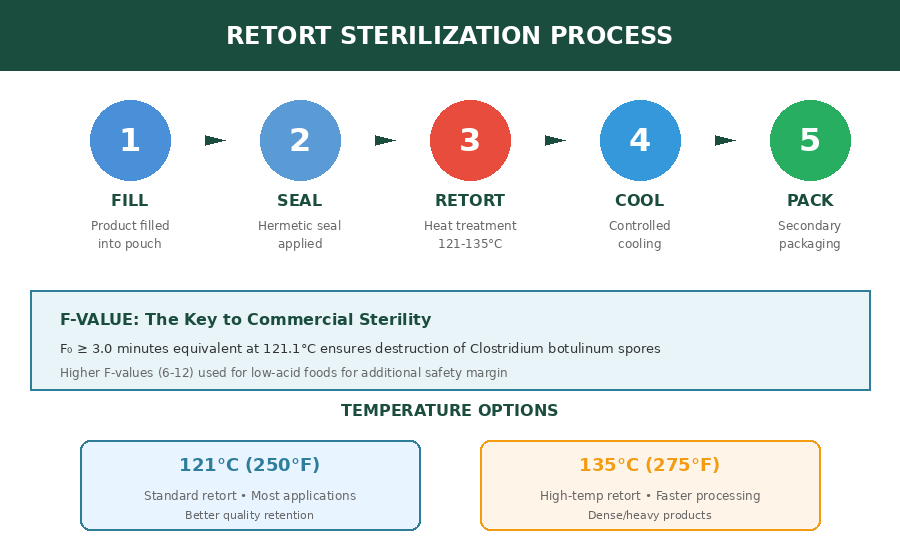
The Five-Step Retort Process
Retort processing transforms perishable foods into shelf-stable products through carefully controlled thermal sterilization:
Step 1: Preparation
Products are prepared (cooking, mixing, cutting) and brought to the appropriate fill temperature. Proper preparation ensures consistent thermal penetration during sterilization.
Step 2: Filling
Products are accurately dosed into pouches using volumetric or gravimetric filling systems. Fill accuracy is critical—overfilling causes seal contamination and failures, while underfilling creates excessive headspace that affects thermal processing.
Step 3: Sealing
Heat sealing creates hermetic closure using precisely controlled parameters:
• Temperature: 180°C–220°C (varies by material)
• Pressure: 2–4 bar
• Dwell time: 1–3 seconds
Seal integrity is the most critical quality factor. A single seal failure can cause product contamination and potential food safety incidents.
Step 4: Retorting (Thermal Sterilization)
Sealed pouches enter the retort (pressure vessel) for sterilization:
Parameter
121°C Process
135°C Process
Temperature
121°C (250°F)
135°C (275°F)
Typical time
20–90 minutes
3–15 minutes
Pressure
1.5–2.5 bar overpressure
2.5–3.5 bar overpressure
Best for
Standard sterilization
HTST (High-Temperature Short-Time)
Back-pressure control is essential during retorting. The pressure differential between pouch interior (expanding from heat) and retort environment must be managed to prevent pouch rupture or deformation.
Step 5: Cooling and Inspection
Pouches are rapidly cooled to below 40°C, then inspected for seal integrity, visual defects, and proper labeling before packaging.
Understanding F-Value: The Core of Retort Science
The F-value (or F0) quantifies the lethality of a thermal process—essentially measuring how effectively a sterilization cycle destroys target microorganisms.
Definition: F0 represents the equivalent time (in minutes) at 121.1°C required to achieve a specific level of microbial destruction, assuming a z-value of 10°C for Clostridium botulinum.
This means the thermal process must deliver lethal effects equivalent to 3+ minutes at 121.1°C at the coldest point of the product (typically the geometric center).
F-Value
Interpretation
F0 < 3.0
Insufficient—food safety risk
F0 = 3.0
Minimum commercial sterility
F0 = 5.0–7.0
Typical commercial processes
F0 > 10.0
Over-processing—quality degradation
121°C vs 135°C: Choosing the Right Temperature
Factor
121°C Standard
135°C HTST
Processing time
20–90 minutes
3–15 minutes
Product quality
Good
Excellent (less thermal damage)
Energy consumption
Higher (longer cycle)
Lower (shorter cycle)
Equipment requirement
Standard retort
High-pressure capable retort
Material requirement
Standard RCPP
High-temp resistant RCPP
Best applications
Most products
Premium meals, heat-sensitive items
Throughput
Lower
Higher
HTST (High-Temperature Short-Time) processing at 135°C delivers equivalent sterilization in a fraction of the time, resulting in better nutrient retention, color preservation, and flavor quality. However, it requires more sophisticated equipment and higher-specification pouch materials.
4. Material Structures: A Technical Deep Dive
The Multi-Layer Architecture
Retort pouches achieve their remarkable performance through carefully engineered multi-layer laminate structures. Each layer serves specific functions:
• Long distribution chains with multiple touch points
Transparent Retort Solutions
For applications requiring product visibility:
Structure
Max Temperature
Barrier Performance
Cost
PET / EVOH / RCPP
121°C
Good (OTR: <1 cc/m²/day)
Medium
PET / AlOx / RCPP
121°C
Better (OTR: <0.5 cc/m²/day)
Higher
PET / SiOx / RCPP
121°C
Good
Medium
Limitation: Transparent structures cannot match aluminum foil's absolute barrier. Maximum shelf life is typically 12–18 months versus 24+ months for foil-based structures.
Material Selection Decision Matrix
Product Type
Recommended Structure
Reason
Standard meat/fish
PET/AL/RCPP
Optimal barrier, cost-effective
Premium ready meals
PET/AL/NY/RCPP
Puncture resistance, flex-crack protection
Wet pet food
PET/AL/NY/RCPP
Durability for handling
Baby food
PET/AL/RCPP (heavy gauge)
Safety margins
Product visibility needed
PET/EVOH/RCPP or PET/AlOx/RCPP
Transparency with adequate barrier
Military/MRE
PET/AL/NY/RCPP (quad laminate)
Maximum durability
5. Why Manufacturers Choose Retort Pouches
Understanding the economic and operational logic behind retort pouch adoption reveals why this packaging format continues to gain market share from traditional metal cans.
5.1 Cost Economics: The TCO Perspective
Smart procurement teams evaluate Total Cost of Ownership (TCO), not just unit packaging price. Retort pouches often deliver lower TCO despite potentially higher per-unit material costs.
Cost Category
Retort Pouch
Metal Can
Savings
Package weight
~15g
~50g
70% reduction
Empty package storage
Flat (minimal space)
Pre-formed (bulky)
80% space savings
Processing time
3–30 minutes
30–90 minutes
42–60% time savings
Energy consumption
Baseline
+30–40%
30–40% energy savings
Transportation cost
Baseline
Significantly higher
Weight + space savings
CO2 emissions
Baseline
+60%
60% carbon reduction
5.2 Product Quality Advantages
Retort pouches deliver measurably superior product quality due to faster thermal penetration:
Quality Factor
Retort Pouch
Metal Can
Why
Nutrient retention
Higher
Lower
Shorter heat exposure
Flavor preservation
Better
More degraded
Less Maillard reaction
Color retention
Excellent
Often faded
Reduced thermal damage
Texture
Natural
Often "mushy"
Minimal over-processing
Metallic taste
None
Possible
No metal contact
For premium product lines—where quality justifies premium pricing—retort pouches are often the only acceptable option.
• Multiple sizes and formats from same production line
• Shorter production runs economically viable
5.4 Market Positioning Advantages
Positioning Factor
Retort Pouch Advantage
Shelf presence
Stand-up format, 360° visibility
Print surface
5-surface printing (front, back, sides, bottom)
Brand differentiation
Custom shapes, premium finishes available
Consumer perception
"Modern" vs. can's "old-fashioned" image
Convenience features
Easy-tear, microwave-safe, resealable options
E-commerce readiness
Lightweight, damage-resistant, shipping-efficient
6. Addressing Common Concerns
Transparent discussion of potential challenges builds trust with procurement decision-makers. Here we address the most common concerns:
6.1 Initial Investment Concerns
The Challenge: Professional FFS (Form-Fill-Seal) retort lines require significant capital investment—approximately $6 million for a complete high-speed line.
The Reality:
• Entry-level systems available from $500K–$1M
• Co-packing partnerships eliminate capital requirements entirely
• ROI typically achieved within 18–36 months
• Operational savings often exceed equipment financing costs
Approach
Investment
Best For
Full FFS line
$3M–$6M+
High-volume producers
Entry-level equipment
$500K–$1M
Mid-volume, testing market
Pre-made pouch filling
$100K–$300K
Lower volume, custom products
Co-packing partnership
$0 (per-unit cost)
Market testing, overflow capacity
6.2 Process Complexity Concerns
The Challenge: Retort processing requires precise control of multiple parameters and specialized knowledge.
Parameter
Control Requirement
Seal temperature
±2°C precision
Seal pressure
±0.1 bar precision
Seal dwell time
±0.1 second precision
Retort temperature
±0.5°C precision
Back-pressure
Continuous adjustment
Solutions:
• Modern equipment includes automated parameter control
• Suppliers provide process development support
• Industry training programs available (e.g., IFTPS - Institute for Thermal Processing Specialists)
6.3 Quality Failure Risks
Failure Type
Cause
Prevention
Seal failure
Contamination, wrong parameters, equipment issues
Seal area inspection, parameter validation, maintenance
Delamination
Adhesive incompatibility, over-processing
Proper material specification, process control
Flex cracking
Handling damage, material fatigue
Nylon layer addition, handling training
Pinhole leaks
Material defects, sharp contents
Incoming inspection, product preparation
6.4 Sustainability Concerns
The Challenge: Multi-layer laminates are difficult to recycle through conventional streams.
Solution
Status
Benefit
Mono-material PP
Commercializing
Fully recyclable in PP stream
PCR content
Available now
30%+ post-consumer recycled content
Chemical recycling
Developing
Handles mixed materials
Reduced material weight
Standard practice
Less material to dispose
6.5 Regulatory Compliance
Region
Primary Regulation
Key Requirements
USA
FDA 21 CFR
Food contact substance notification, process filing
Market Context: The global convenience food market's expansion directly drives retort pouch demand. Busy lifestyles and smaller household sizes fuel growth.
Typical Products:
• Rice dishes and grain bowls
• Pasta meals
• Curries and stews
• Soups and broths
Why Retort Pouches Dominate:
• Microwave heating in 60–90 seconds
• Portion control for single servings
• Premium quality perception vs. frozen meals
7.2 Pet Food (Fastest Growing - 8.1% CAGR)
Market Context: Pet humanization trends drive demand for premium wet food formats. Pet owners increasingly reject "canned" perception for their companions' food.
Market Data:
• Wet pet food market: $28+ billion globally
• Pouch format growing faster than any other wet pet food packaging
• Premium segment commands 40%+ price premium
7.3 Baby Food
Market Context: Safety requirements and portion control needs make retort pouches ideal for infant nutrition.
Key Requirements:
• Highest safety standards (no migration risks)
• Single-serve portions
• Squeeze-pouch formats for self-feeding toddlers
• Transparent windows for product visibility
7.4 Seafood
Market Context: The tuna pouch pioneered U.S. mainstream retail adoption of retort pouches in the early 2000s.
Benefits for Seafood:
• No "canned fish" texture or taste
• Better omega-3 retention
• Premium positioning opportunity
• Extended shelf life for distribution
7.5 Military and Emergency Preparedness
Market Context: Military MRE (Meals Ready-to-Eat) programs drove early retort pouch development and remain significant demand drivers.
Requirements:
• Extreme durability (drop tests, temperature cycling)
• 3+ year shelf life
• Operational in extreme conditions (-40°C to +60°C)
• Lightweight for soldier carry
8. Retort Pouch vs Metal Can: Complete Comparison
Factor
Retort Pouch
Metal Can
Winner
Package weight
~15g
~50g
Pouch (70% lighter)
Storage space (empty)
Flat storage
Pre-formed, bulky
Pouch (80% less space)
Processing time
3–30 min
30–90 min
Pouch (faster)
Energy consumption
Baseline
+30–40%
Pouch
Product quality
Superior
Adequate
Pouch
Shelf appeal
5-surface printing
Label only
Pouch
Convenience features
Easy-open, resealable
Requires opener
Pouch
Durability (rough handling)
Good (with nylon layer)
Excellent
Can
Absolute barrier
Excellent
Excellent
Tie
Recyclability (current)
Developing
Established
Can
Capital investment
Higher
Lower (existing lines)
Can
Perceived quality
Premium
Traditional
Pouch
Bottom Line: Retort pouches win on most performance and efficiency metrics. Metal cans remain advantageous where extreme durability is required, where existing production lines exist, or in markets where recycling infrastructure doesn't support flexible packaging.
9. How to Order
Information Required for Quotation
Category
Information Needed
Product
Contents, fill weight, pH, fat content, particulate size
Process
Retort temperature (121°C or 135°C), target shelf life
Volume
Annual quantity, order frequency
Format
Stand-up, flat, spouted; dimensions or fill volume
Features
Zipper, tear notch, hang hole, microwave vent
Printing
Number of colors, artwork requirements
Compliance
Target markets, certification requirements
Typical Lead Times
Stage
Timeline
Quotation
2–3 business days
Sample production
7–14 days
Process validation
Customer dependent
Production (stock size)
2–3 weeks
Production (custom)
4–6 weeks
Minimum Order Quantities
Configuration
Typical MOQ
Stock sizes (no printing)
5,000 pieces
Custom printing
10,000–50,000 pieces
Custom size + printing
50,000+ pieces
Sample Testing Process
5. Request samples with your product specifications
6. Conduct filling trials at your facility
7. Perform retort validation with temperature monitoring
8. Complete incubation testing (10 days at 37°C)
9. Evaluate seal integrity and product quality
10. Proceed to production order upon successful validation
10. Frequently Asked Questions
Q1: What is the shelf life of products in retort pouches?
Properly processed retort pouch products achieve 12–24 months of ambient shelf life. Aluminum foil structures provide the longest shelf life (24+ months), while transparent structures typically offer 12–18 months due to lower barrier performance.
Q2: Can retort pouches be microwaved?
Yes, most retort pouches are microwave-safe. The aluminum foil layer, however, must be accounted for—pouches with aluminum should be opened or vented before microwaving, or use microwave-specific venting features. Transparent (non-foil) pouches can typically be heated directly.
Q3: What is the difference between 121°C and 135°C retort pouches?
Both achieve commercial sterility, but 135°C pouches use High-Temperature Short-Time (HTST) processing. 135°C processing requires higher-specification materials (135°C-rated RCPP) but delivers better product quality due to shorter heat exposure. Equipment capable of higher pressures is also required.
Q4: Are retort pouches BPA-free?
Yes, modern retort pouches are manufactured with BPA-free materials. Reputable suppliers provide documentation confirming compliance with food contact regulations including BPA-free certification.
Q5: How do retort pouches compare to cans for sustainability?
While metal cans have established recycling streams, retort pouches offer significantly lower overall environmental impact: 60% lower CO2 emissions, 70% less material by weight, lower transportation energy. Mono-material and recyclable solutions are emerging. Life cycle assessments increasingly favor pouches when total environmental impact is considered.
Q6: What causes retort pouch seal failures?
Common causes include: seal area contamination (product residue), incorrect seal parameters (temperature, pressure, time), equipment maintenance issues, and material defects. Prevention requires proper equipment calibration, regular maintenance, operator training, and quality control protocols.
Q7: Can any product be packed in retort pouches?
Most shelf-stable food products can be packed in retort pouches. Considerations include: product pH (affects process requirements), particulate size (affects thermal penetration), fat content (affects material selection), and sharp components (may require heavier materials). Your supplier can recommend appropriate structures for specific products.
Q8: What is the minimum order quantity?
MOQs vary by configuration: stock sizes require 5,000 pieces minimum, custom printing requires 10,000–50,000 pieces, and fully custom configurations require 50,000+ pieces. Many suppliers offer lower MOQs for initial trials at adjusted pricing.
Q9: How do I validate retort pouch processes?
Validation involves: (1) Heat distribution study (ensure uniform retort heating), (2) Heat penetration study (confirm F-value at cold point), (3) Seal integrity testing, (4) Incubation testing (confirm commercial sterility), and (5) Regulatory filing (if required, e.g., FDA LACF). Equipment suppliers and contract testing laboratories provide validation services.
Q10: What certifications should retort pouch suppliers have?
Key certifications include: ISO 9001 (Quality Management), ISO 22000 / FSSC 22000 (Food Safety), BRC Packaging (Global Standard), FDA registration (for US market), and material compliance documentation (FDA, EU, etc.).
Ready to Explore Retort Packaging?
Retort pouches combine the shelf-stability of traditional canning with the performance, efficiency, and market appeal of modern flexible packaging. Whether you're launching a new product line or evaluating alternatives to metal cans, understanding the technology, economics, and operational requirements is the first step.
Next Steps:
11. Define your requirements using our specification checklist
12. Request samples for your specific product
13. Conduct validation testing with supplier support
14. Evaluate total cost of ownership beyond unit price
Contact usfor a consultation on your retort packaging project. Our technical team can recommend optimal structures, provide samples, and support your process validation.
Data Sources
This guide was prepared using data from Grand View Research, Fortune Business Insights, Mordor Intelligence, and industry technical literature. Market data reflects 2024 figures and projections.
Select your packaging needs by filtering through our comprehensive categories. If you don't find what you're looking for, feel free to contact us for custom solutions.