Quick Answer: Stand up pouch sizes are expressed as W × H + D (Width × Height + Bottom Gusset Depth) in millimeters. Common sizes range from 100×150+60mm (50ml) to 280×400+120mm (3kg). For optimal appearance and stability, fill pouches to 70-80% capacity. When in doubt, request samples before committing to a large order.
Choosing the right pouch size is critical for product presentation, shelf impact, and cost efficiency. This guide explains how to read dimensions, select the perfect size for your product, and avoid costly mistakes.
Understanding Stand Up Pouch Dimensions
The standard notation for stand up pouch dimensions is W × H + D where each letter represents a specific measurement:
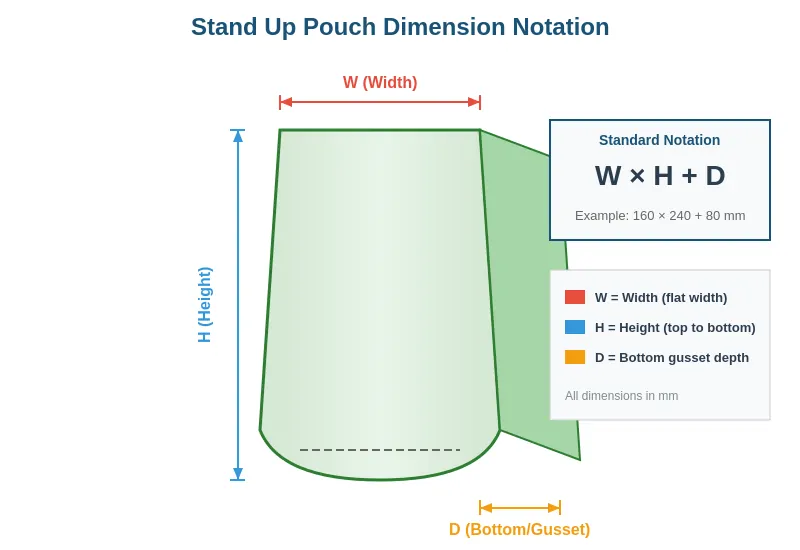
Dimension Definitions
• W (Width): The flat width of the pouch when laid flat, measured from left edge to right edge. This is the dimension that faces the customer on shelf.
• H (Height): The total height from the bottom of the gusset to the top seal. Includes the seal area (typically 5-10mm).
• D (Depth/Bottom): The depth of the bottom gusset when expanded. This determines standing stability and base footprint.
�� Pro Tip: The bottom gusset depth (D) is typically 40-60% of the width (W) for optimal stability. A 160mm wide pouch usually has an 80-100mm bottom gusset.
Standard Stand Up Pouch Sizes
While custom sizes are available, most products fit within these standard size categories:

Figure 2: Visual comparison of standard pouch sizes
Size | Dimensions (mm) | Capacity | Typical Products | Best For |
XS | 100 × 150 + 60 | 50-100ml | Samples, single-serve | Trial packs, sachets |
S | 130 × 200 + 70 | 100-250ml | Snacks, candy, tea | Retail snack packs |
M | 160 × 240 + 80 | 250-500ml | Coffee, nuts, granola | Most popular size |
L | 200 × 300 + 100 | 500ml-1L | Pet treats, protein | Family/value packs |
XL | 280 × 400 + 120 | 1-3kg | Pet food, bulk items | Bulk/wholesale |
How to Choose the Right Size
Follow this 4-step process to determine the optimal pouch size for your product:
Step 1: Calculate Product Volume
Determine your product's actual volume by weight and density. For powders and granules, account for settling during transit (add 10-15% extra space).
Step 2: Apply the 70-80% Fill Rule

Figure 3: Optimal fill rate for best appearance and stability
For professional appearance and proper standing stability, fill pouches to 70-80% of total capacity. This leaves room for the top seal and allows the pouch to stand properly.
Step 3: Consider Shelf Space
Check your retail partner's shelf dimensions. Standard retail shelves are typically 30-40cm deep. Ensure your pouch depth (when filled) doesn't exceed available space.
Step 4: Request Samples
Always request samples in 2-3 potential sizes before committing to a production run. Fill them with your actual product to verify fit, appearance, and stability.
Capacity Calculation Formula
Approximate Volume (ml) = W × D × H × 0.6 ÷ 1000
Where W, D, H are in millimeters. The 0.6 factor accounts for the tapered shape and seal areas.
Example: 160 × 80 × 240 × 0.6 ÷ 1000 = ~1,843ml theoretical capacity. At 75% fill rate, usable capacity is ~1,380ml.
5 Common Sizing Mistakes to Avoid
❌ Mistake 1: Choosing size by capacity alone
A 500ml pouch for a dense product (like nuts) will look very different from a 500ml pouch for a light product (like chips). Always consider product density.
❌ Mistake 2: Ignoring the bottom gusset
A too-narrow gusset won't provide stability. A too-wide gusset wastes material and shelf space. Aim for D = 50% of W as a starting point.
❌ Mistake 3: Overfilling pouches
Pouches filled above 85% look bloated, don't stand well, and are prone to seal failure. Leave headspace for proper sealing and aesthetics.
❌ Mistake 4: Not accounting for seal area
The top 10-15mm of height is used for sealing and cannot hold product. Factor this into your calculations.
❌ Mistake 5: Skipping sample testing
Paper specifications never tell the whole story. Always fill actual samples with your real product before ordering thousands of pouches.
Frequently Asked Questions
Q: Can I get custom sizes not listed in standard charts?
A: Yes. Most manufacturers, including Sunkey, can produce custom sizes. However, custom sizes may have higher MOQs and longer lead times. Standard sizes are often more cost-effective.
Q: How do I convert between ml and grams?
A: It depends on product density. Water: 1ml = 1g. Coffee beans: 1ml ≈ 0.4g. Ground coffee: 1ml ≈ 0.5g. Nuts: 1ml ≈ 0.6g. Always test with your specific product.
Q: What's the minimum and maximum size available?
A: Stand up pouches can range from 80×120+50mm (sample sachets) to 400×500+150mm (bulk packaging). Extremely large sizes may require special equipment.
Q: Does zipper or spout affect size selection?
A: Yes. Zippers add 15-20mm to the height requirement. Spouts require additional header space (typically 30-40mm). Account for these features when calculating usable volume.
Q: How do I request size samples?
A: Contact Sunkey Packaging with your product type, target weight/volume, and preferred material. We'll recommend 2-3 suitable sizes and send samples for testing.
Need Help Choosing the Right Size?
Our packaging experts can help you select the perfect pouch size for your product. We offer:
• Free size consultation and recommendations
• Sample pouches in multiple sizes for testing
• Custom size production with competitive MOQs
• Quick turnaround on standard sizes
Related Articles
• What is a Stand Up Pouch? Complete Guide
• Stand Up Pouch Materials: PET vs AL vs PE
• Stand Up Pouch vs Flat Bottom Bag: Which to Choose?


